The Material Choice That Defines Electrical Safety in Switchgear
In the architecture of modern power distribution equipment, busbar support insulators occupy a quietly critical role. They hold current-carrying copper and aluminum conductors in fixed geometric positions, enforce galvanic isolation from grounded chassis structures, and must endure a continuous combination of dielectric stress, thermal cycling, mechanical shock, and chemical exposure—often for decades without replacement. For engineers and panel builders selecting insulation materials, the choice between thermoset composites such as BMC (Bulk Molding Compound) and SMC (Sheet Molding Compound) versus engineering thermoplastics such as nylon and polycarbonate is not a matter of preference. It is a matter of physics, chemistry, and verified performance data.
DOWE Electric, a Yueqing-based manufacturer with more than two decades of specialization in electrical insulation systems for global power distribution infrastructure, has built its entire product engineering around thermoset composite chemistry. Understanding why requires examining the precise failure mechanisms that thermoplastics introduce into switchgear and busbar applications.
The Core Problem with Nylon and Thermoplastics in High-Voltage Environments
Thermoplastics, including nylon (polyamide), polycarbonate, and PBT, are processed by melting and reshaping, which means their polymer chains remain physically entangled but not chemically cross-linked. Under sustained thermal loading, thermoplastics soften progressively as they approach their glass transition temperature. In switchgear enclosures where busbars carry continuous current and generate resistive heat, this softening translates directly into dimensional instability.
More critically, thermoplastics present a surface tracking hazard that thermosets do not. When a conductive film—moisture, dust, or carbonized residue—forms on a thermoplastic insulator surface and an arc event initiates, the surface can carbonize and create a permanent, low-resistance conductive path. This phenomenon, known as surface tracking, is quantified by the Comparative Tracking Index (CTI). Many general-purpose thermoplastics achieve CTI values in the 175V to 400V range, placing them in Material Group III or IV—categories associated with elevated tracking risk in Pollution Degree 3 industrial environments.
By contrast, BMC and SMC thermoset composites undergo irreversible chemical cross-linking during cure. This molecular architecture eliminates the softening-on-heating behavior and produces a material that resists surface carbonization even under arc exposure. DOWE Electric's BMC and SMC formulations achieve a CTI of 600V or higher, placing them in Material Group I—the highest classification under IEC standards—for resistance to conductive carbon tracking.
Thermal Performance: Where Thermosets Maintain Structural Integrity
One of the most widely misunderstood distinctions between thermosets and thermoplastics concerns high-temperature mechanical behavior. A nylon 66 component rated for 120°C continuous use will begin losing flexural stiffness well before reaching that threshold under applied load. In busbar support applications, where short-circuit electrodynamic forces and thermal cycling create compressive and shear stress simultaneously, stiffness retention under load is non-negotiable.
DOWE Electric's thermoset composites maintain structural rigidity under a 1.8 MPa flexural load up to a Heat Deflection Temperature (HDT) of +180°C—a threshold that standard engineering thermoplastics do not approach under comparable load conditions. Additionally, the materials carry a Relative Thermal Index (RTI) of 130°C for both electrical and mechanical properties, certified per UL 746B. For new energy applications including battery energy storage systems and solar inverter DC links, the operating temperature endurance spans from -40°C to +140°C without embrittlement or structural softening.
This thermal stability has direct implications for the CTE (Coefficient of Thermal Expansion) compatibility between insulators and the conductors they support. Copper busbars expand at 16.5 × 10⁻⁶ /K; aluminum at 23.1 × 10⁻⁶ /K. DOWE Electric's thermoset composite formulations are engineered with a CTE of 15–22 × 10⁻⁶ /K—closely matched to both conductor materials. Thermoplastics typically exhibit significantly higher CTE values, generating differential thermal stress at the conductor-insulator interface during load cycling and potentially loosening clamping torque over time.
Dielectric and Fire Performance Standards That Thermoplastics Cannot Match
In enclosed switchgear, an internal arc fault creates a rapid overpressure and a sustained arc column that can ignite surrounding insulation materials. Standard nylon grades are not inherently flame retardant; achieving UL 94-V0 rating in thermoplastics frequently requires halogen-based flame retardant additives, which introduce separate concerns related to toxic gas evolution and RoHS compliance.
DOWE Electric's BMC and SMC composite products achieve UL 94-V0 self-extinguishing flame retardancy intrinsically through their thermoset resin matrix, with afterflame time t₁ + t₂ no greater than 8 seconds and zero flaming drips. The materials comply with RoHS 2011/65/EU, the 2015/863 amendment, and REACH (EC 1907/2006), enabling straightforward access to European and North American markets without additional chemical compliance hurdles.
On the dielectric side, DOWE's low-voltage standoff products withstand 3,500V AC at 50Hz for one minute without puncture or flashover, and survive 1.2/50 μs impulse overvoltage up to 8kV—corresponding to Overvoltage Category IV per IEC 60664-1. These figures are verified through SGS third-party type testing, and DOWE provides the resulting test reports so that panel builders can complete their own Design Verification documentation without independent destructive testing.
Product Engineering Across Low-Voltage and Medium-Voltage Applications
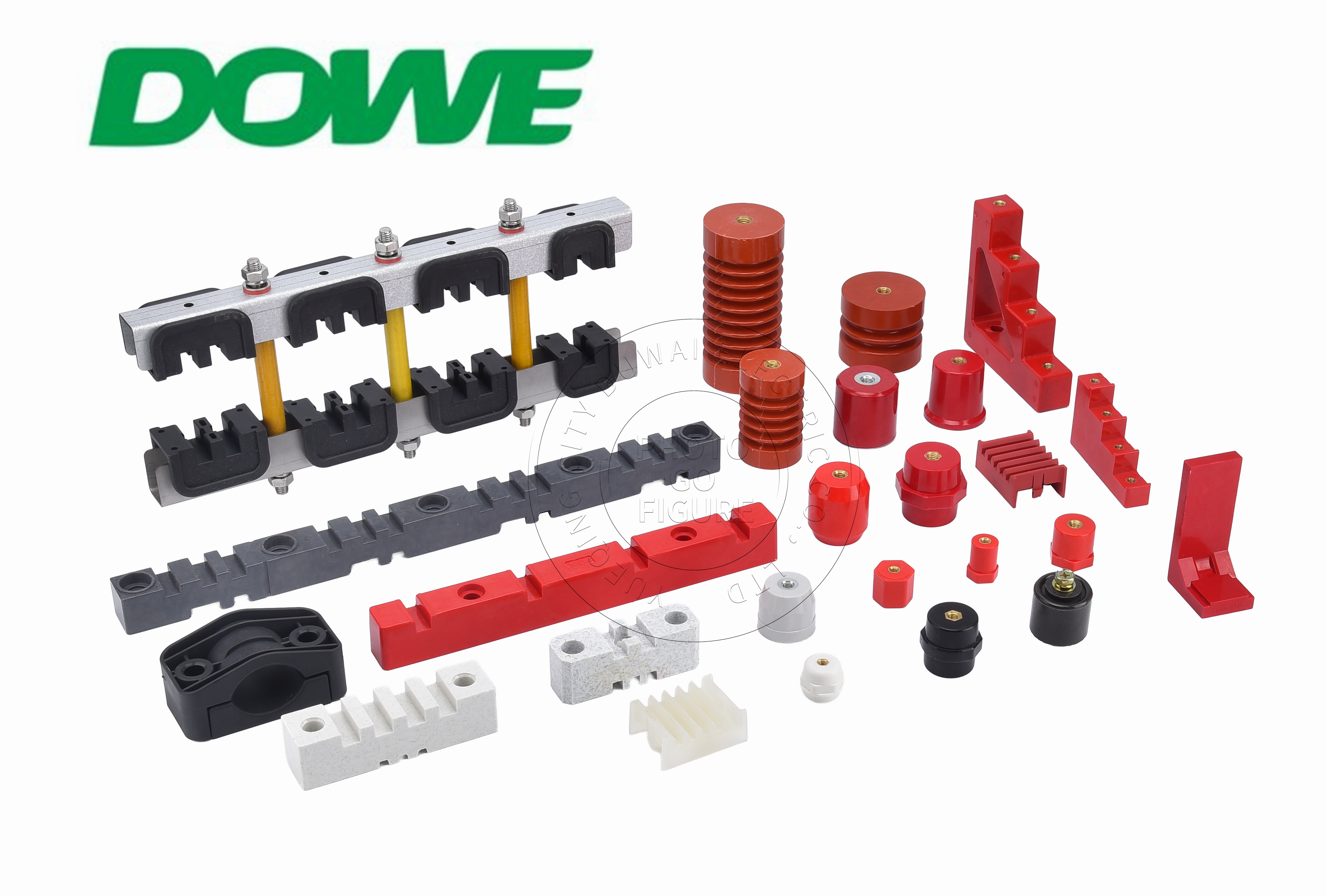
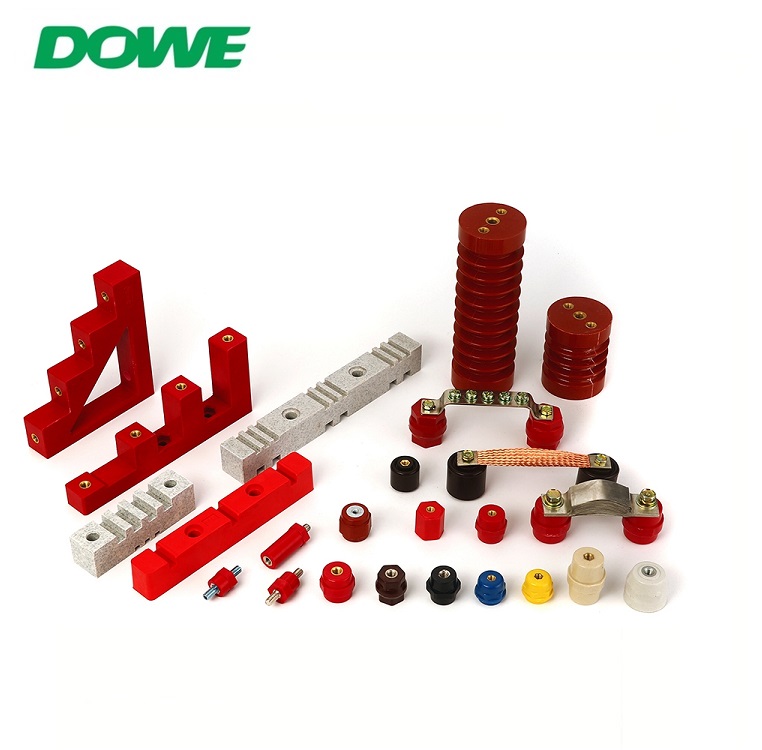
DOWE Electric's thermoset composite expertise is deployed across a broad product matrix. The SB/JYZ Series of hexagonal-base standoff insulators is purpose-designed for high-voltage DC systems operating at up to 1,500V DC, covering solar PV combiner boxes, BESS storage cabinets, lithium battery module isolation, and EV fast charging terminals. The SM Series conical ribbed standoff extends surface creepage path by 35% to 60% through aerodynamic fin geometry, targeting standard low-voltage switchgear and motor control center cabinets.
For busbar clamping and multi-phase retention, the EL Series and HC Heavy Duty line address short-circuit withstand requirements from 250A to 6,300A, with HC units rated for Icw up to 100kA/1s at utility substation installations. DOWE Electric's precision dimensional engineering enables 1:1 drop-in OEM replacement for ABB MNS, Schneider Blokset/Okken, Siemens Sivacon, GE, and Eaton switchgear platforms—allowing facilities managers to replace aging insulation without panel redesign.
At medium voltage, the EL MV Series vacuum-cast epoxy resin insulators serve 3.6kV to 7.2kV AC applications in harsh industrial environments, ring main units, and variable frequency drive cabinets, delivering volume resistivity greater than 10¹⁴ Ω·cm and partial discharge below 5 pC at 1.1 Um.
Why Material Selection Matters at the System Level
The selection of busbar support insulation is not a line-item cost decision. It is a system-level engineering decision with consequences for panel longevity, fire safety, regulatory compliance, and field serviceability. BMC and SMC thermoset composites, as deployed across DOWE Electric's product range, deliver a combination of tracking resistance, thermal stability, dimensional precision, flame retardancy, and dielectric withstand that standard engineering thermoplastics are structurally unable to replicate. For panel builders, switchgear OEMs, and turnkey EPC contractors operating in markets from Germany and the United States to Southeast Asia and Australia, the material specification that starts on the drawing board determines the performance envelope that holds for the life of the installation.
http://www.busbarinsulator.com
Yueqing City DUWAI Electric Co.,LTD
About Author