Specifying low-voltage busbar insulators for switchgear and panelboard assemblies is a decision that directly influences the long-term safety, reliability, and regulatory compliance of power distribution infrastructure. As IEC 61439-1/2 establishes performance verification requirements for low-voltage switchgear and controlgear assemblies, panel builders and switchgear OEMs face increasing pressure to source insulation components that satisfy not just dimensional fit but a layered set of dielectric, thermal, mechanical, and flame-retardancy criteria. Getting specification right at the component level prevents costly design verification failures downstream.
Why Insulator Specification Matters Under IEC 61439
IEC 61439-1/2 requires that all insulating materials used in low-voltage switchgear assemblies demonstrate compliance with defined performance properties — including resistance to heat, fire, tracking, and environmental contamination. The standard does not simply accept a material by type; it demands traceable test evidence. For panel builders operating under design verification obligations, sourcing insulators backed by third-party type test reports from recognized bodies significantly reduces the burden of independent destructive testing. This is the foundational reason why insulator material selection and certification documentation must be addressed early in the design cycle.
Criterion 1: Comparative Tracking Index (CTI)
Tracking resistance is the single most critical electrical property for low-voltage busbar insulators installed in industrial and commercial switchgear environments. In Pollution Degree 3 industrial environments — where conductive dust, humidity, and condensation are present — a carbonized tracking path across an insulator surface between adjacent live busbars or between a live busbar and a grounded chassis represents a direct failure mode.
The Comparative Tracking Index (CTI) classifies materials into groups. A CTI of 600V or higher places a material in Material Group I, representing the highest resistance to conductive carbon tracking. Panel builders specifying for IEC 61439-compliant assemblies should require Material Group I insulators as a baseline for any installation where contamination or humidity is anticipated. This is especially relevant for distribution panelboards serving industrial, marine, or outdoor-proximate environments.
Criterion 2: Flame Retardancy and Self-Extinguishing Properties
Enclosed switchgear assemblies concentrate significant fault energy within confined metallic enclosures. In the event of an internal arc fault or localized overheating, non-compliant plastic insulation can become an ignition source rather than a barrier. UL 94-V0 is the benchmark flame-retardancy classification for switchgear insulation materials. Under UL 94-V0 criteria, a material must self-extinguish with afterflame time t1 + t2 no greater than 8 seconds and produce zero flaming drips that could propagate fire to adjacent components. Specifiers should require UL 94-V0 certification with documented test evidence — not manufacturer self-declaration alone.
Criterion 3: Operating Temperature Range and Thermal Stability
Busbars carrying rated current generate continuous thermal loading. Insulators must maintain dimensional stability and mechanical load-bearing capability across the full operating temperature range of the assembly. For standard low-voltage switchgear, this typically means continuous performance from ambient conditions up to elevated thermal classes. For new energy applications — including battery energy storage systems (BESS), solar PV combiner cabinets, and EV charging infrastructure operating in outdoor or partially conditioned environments — the operating temperature window can extend from -40°C to +140°C.
Heat Deflection Temperature (HDT) under a 1.8 MPa flexural load is the relevant metric for structural insulators subjected to both thermal and mechanical stress simultaneously. Specifiers should also consider the Coefficient of Thermal Expansion (CTE) of the insulator material relative to the copper or aluminum busbars it supports. A CTE in the range of 15–22 × 10⁻⁶ /K is well-aligned with copper at 16.5 × 10⁻⁶ /K and aluminum at 23.1 × 10⁻⁶ /K, reducing differential expansion stress at mounting interfaces over repeated thermal cycling.
Criterion 4: Mechanical Load Capacity and Insert Integrity
Busbar insulators must withstand both static cantilever loads from busbar weight and dynamic electromagnetic forces during short-circuit events. The tensile pull-out resistance of threaded inserts — particularly for M8 and M10 thread interfaces — is a measurable performance indicator. Insert pull-out values greater than 8,000 N provide a quantifiable margin for bolted busbar connections. Torsional lock should exceed 1.5× the bolt proof torque to prevent insert rotation during assembly.
Material selection between BMC (Bulk Molding Compound) and SMC (Sheet Molding Compound) affects structural performance. SMC formulations, which incorporate longer glass fibers in the range of 25mm to 50mm, deliver superior flexural and tensile strength, making them the preferred choice for higher-current busbar support applications and environments with elevated short-circuit forces.
Criterion 5: Dimensional Compatibility with Platform Switchgear
For retrofit and replacement applications in existing switchgear assemblies — particularly platforms such as ABB MNS 2.0/3.0 drawer cabinets, Schneider Blokset and Okken assemblies, and Siemens Sivacon systems — dimensional matching is non-negotiable. A 1:1 drop-in replacement insulator must replicate original mounting hole centers, busbar slot spacing, and creepage path geometry precisely. Any deviation introduces redesign costs, extended delivery timelines, and potential IEC 61439 re-verification obligations. Specifiers working on panel retrofits should explicitly require dimensional conformance documentation rather than accepting functional equivalence claims without measurement data.
Criterion 6: Environmental Compliance for Cross-Border Markets
For switchgear assemblies destined for European and North American markets, RoHS 2011/65/EU (as amended by 2015/863) and REACH (EC 1907/2006) compliance are regulatory prerequisites rather than optional features. These directives restrict hazardous substances in electrical and electronic equipment, and non-compliant components can block CE clearance and halt shipment through customs.
How DOWE Electric Addresses These Specification Requirements
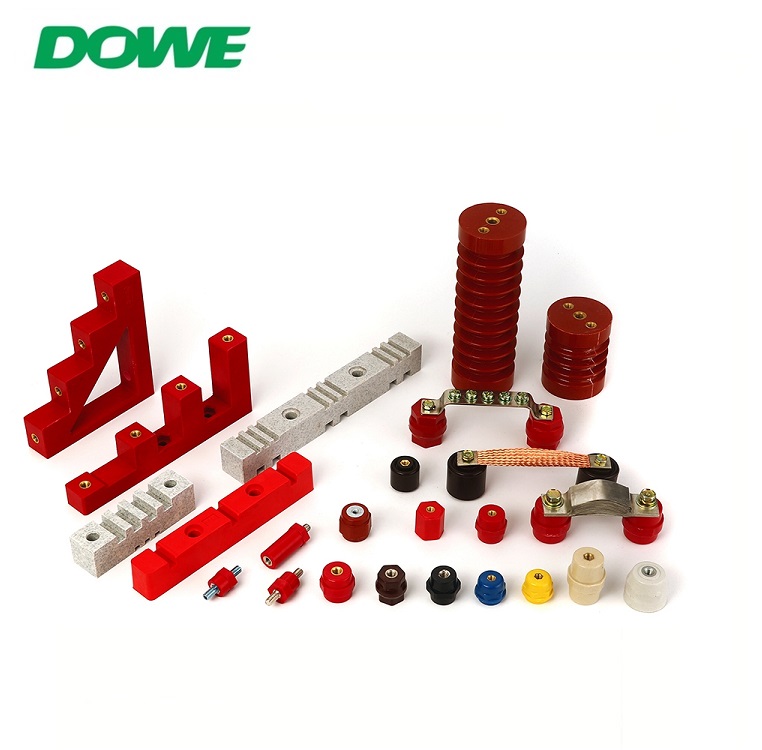
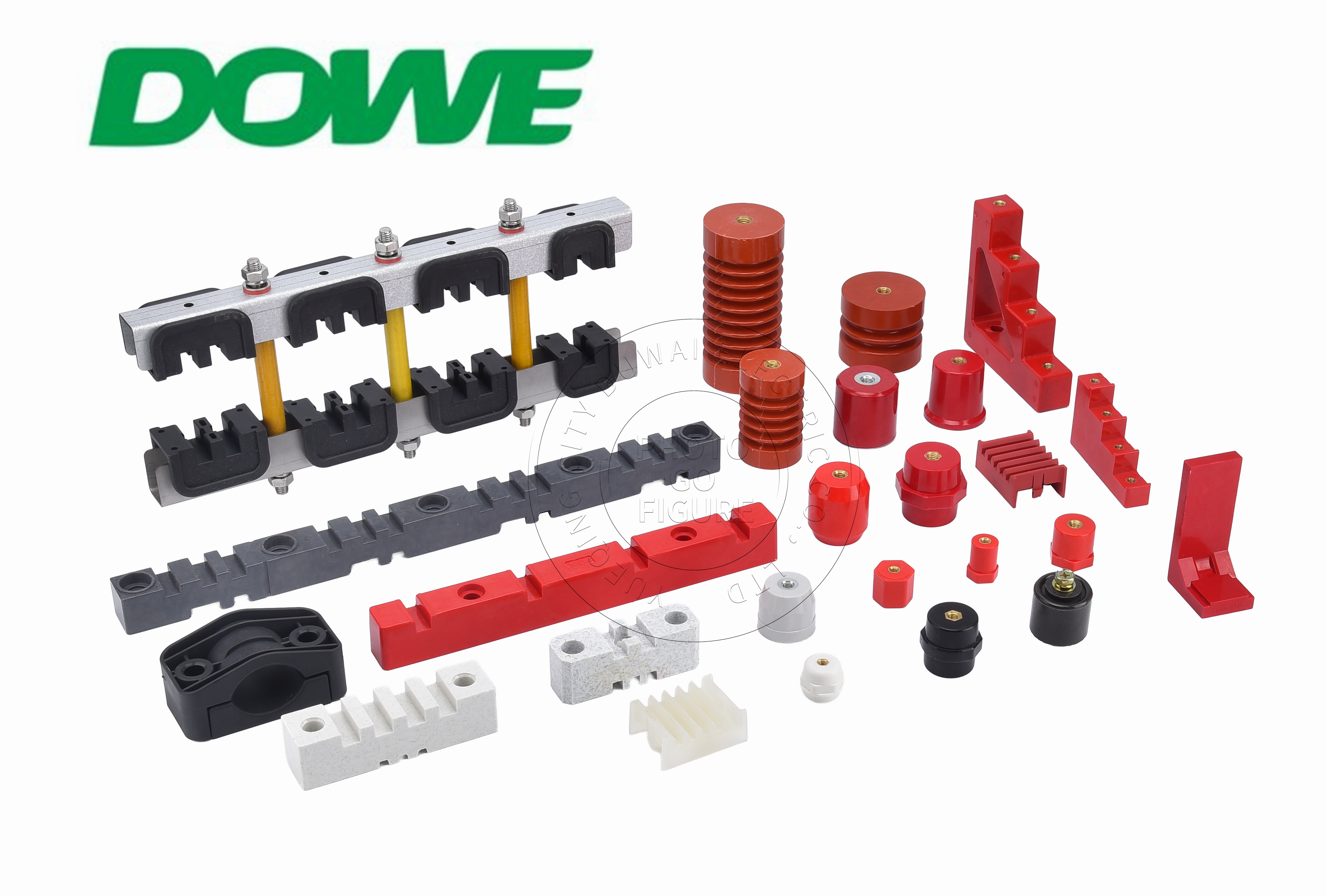
DOWE Electric (Yueqing City Duwai Electric Co., Ltd.) has positioned its insulation product portfolio directly against the specification criteria outlined above. The company's BMC and SMC standoff insulators carry a CTI of 600V or higher — Material Group I — and hold UL 94-V0 flame retardancy certification with documented afterflame performance within the 8-second threshold and zero flaming drips. Operating temperature endurance from -40°C to +140°C addresses both standard switchgear and new energy applications in the same product family.
DOWE's low-voltage standoff product lines include the SM Series for standard conical ribbed configurations, the SB/JYZ Series purpose-engineered for high-voltage DC applications up to 1,500V DC in solar PV, BESS, and EV charging infrastructure, and the MNS Series delivering 1:1 dimensional matching for ABB MNS 2.0/3.0 drawer-type cabinet retrofits. For multi-phase busbar retention, the EL Series and HC Heavy Duty busbar support systems address configurations from 250A up to 6,300A with short-circuit withstand ratings of Icw up to 100kA/1s.
From a compliance documentation standpoint, DOWE provides SGS third-party type test reports that panel builders can reference directly to complete Design Verification documentation under IEC 61439, eliminating the need for independent destructive testing programs. RoHS, REACH, and CE clearances enable frictionless entry into European and North American markets. The company exports to more than 60 countries and maintains production capacity exceeding 500,000 low-voltage standoffs per month, supporting high-volume procurement programs without extended lead times.
Bringing the Specification Together
A rigorous busbar insulator specification for IEC 61439-compliant switchgear and panelboards integrates CTI classification, UL 94-V0 flame retardancy, thermal endurance data, mechanical insert performance, dimensional conformance documentation, and environmental compliance certificates into a single sourcing evaluation. Panel builders who treat insulator selection as a commodity decision — rather than a verified engineering choice — expose their assemblies to tracking failures, thermal degradation, mechanical loosening, and compliance audit risk. The selection framework outlined here provides a structured basis for insulator procurement decisions that hold up under both operational conditions and third-party design verification review.
http://www.busbarinsulator.com
Yueqing City DUWAI Electric Co.,LTD
About Author