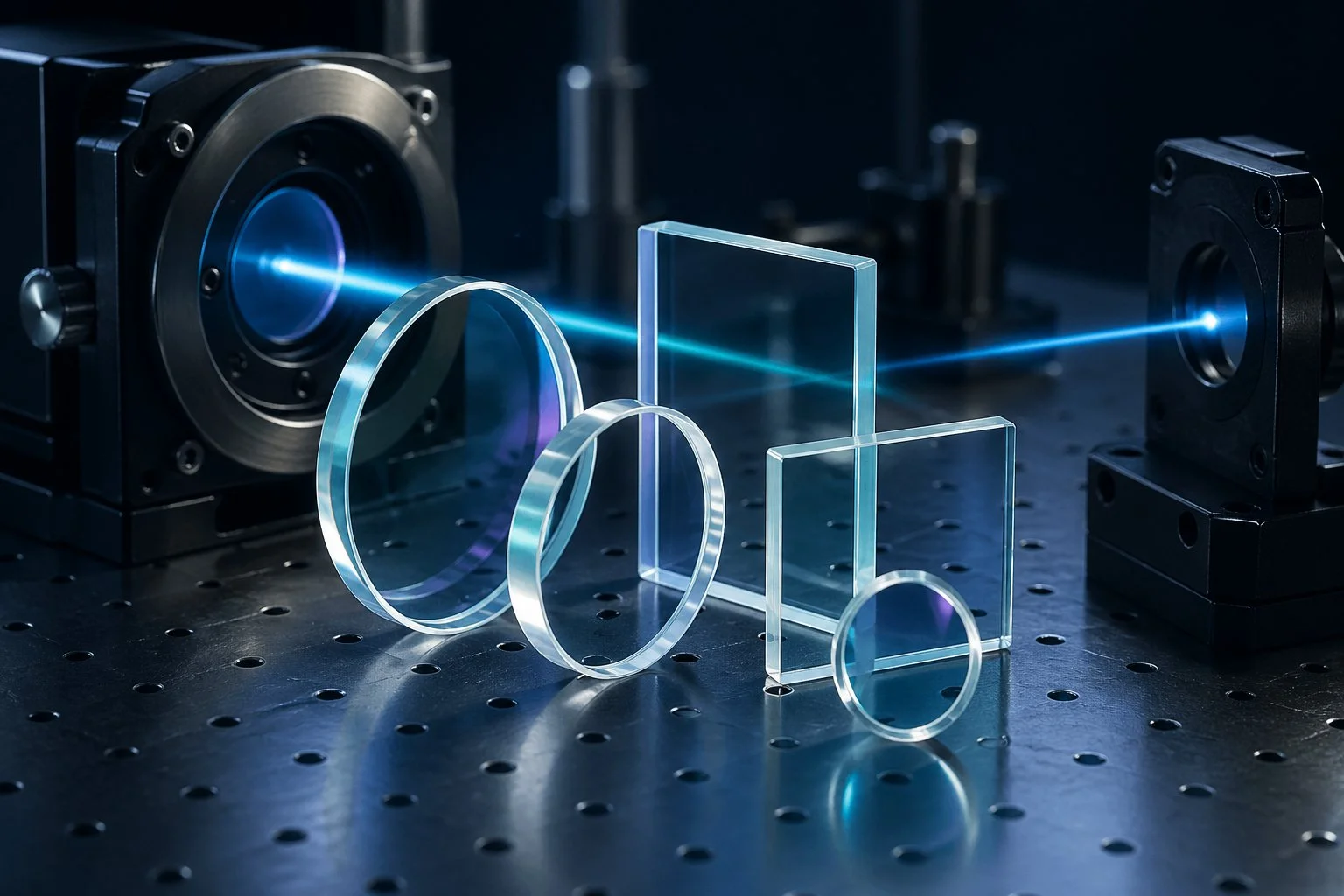
In modern photonics and precision engineering, system reliability depends heavily on environmental stability and optical accuracy. Whether in aerospace sensors, laser processing equipment, or medical imaging systems, even minor contamination or mechanical disturbance can significantly degrade performance. This is where optical windows play a critical role.
Well-designed optical windows are not just passive glass components—they are engineered protective elements that safeguard sensitive optical instruments while maintaining excellent light transmission and minimal wavefront distortion. In high-performance systems, they function as a crucial interface between controlled internal environments and harsh external conditions.
1. Understanding Optical Windows in Optical Systems
Optical windows are flat, transparent components designed to transmit light while protecting internal optical assemblies. Unlike lenses, they do not alter focal length or image formation. Their primary purpose is to preserve optical integrity while acting as a physical barrier.
In most optical systems, optical windows are installed at the front aperture or system interface, ensuring that light can pass through with minimal loss while shielding internal components from environmental exposure.
Key performance requirements typically include:
-
High optical transmission across specific wavelength ranges
-
Excellent surface flatness and parallelism
-
Low absorption and scattering
-
Mechanical durability under stress conditions
Because of these characteristics, optical windows are widely used in scientific instruments, industrial equipment, and precision imaging systems.
2. Environmental Protection for Sensitive Optical Instruments
One of the most important functions of optical windows is environmental isolation. Sensitive optical instruments are extremely vulnerable to external conditions such as dust, humidity, and chemical exposure.
2.1 Dust and Particle Shielding
In precision optical systems, even microscopic particles can scatter incoming light and reduce signal clarity. By sealing the system opening, optical windows prevent dust contamination from reaching internal optical components such as lenses, detectors, or laser cavities.
2.2 Moisture and Humidity Control
Water vapor is another major threat in optical environments. It can condense on internal surfaces, causing fogging or corrosion of coatings. Optical windows act as a sealed barrier that maintains a controlled internal atmosphere, improving long-term system stability.
2.3 Chemical and Corrosive Resistance
In industrial environments, optical instruments may be exposed to corrosive gases or chemical vapors. High-quality optical windows, often made from fused silica or sapphire, provide strong resistance to chemical attack and protect internal optics from degradation.
3. Mechanical Protection and Structural Safety
Beyond environmental isolation, optical windows also serve as a mechanical protective layer. Many optical instruments operate in environments where physical impact or vibration is unavoidable.
3.1 Impact Protection
Optical components such as mirrors, sensors, and precision lenses are highly sensitive to mechanical damage. The optical window absorbs external impact, preventing direct contact with these fragile components.
3.2 Vibration Resistance
In aerospace systems, industrial machinery, or mobile optical devices, vibration is a common challenge. Properly mounted optical windows help stabilize the optical path and reduce mechanical stress transmitted to internal components.
3.3 Replaceable Protection Layer
In many designs, optical windows are treated as replaceable elements. If the window becomes scratched or contaminated, it can be replaced without disturbing the alignment of the internal optical system, significantly reducing maintenance costs.
4. Maintaining Optical Performance While Providing Protection
A key engineering challenge is ensuring that protective functions do not degrade optical performance. High-quality optical windows are designed to preserve system accuracy while providing full environmental shielding.
4.1 High Transmission Efficiency
Materials such as fused silica, BK7 optical glass, and sapphire are commonly used due to their excellent transmission properties across ultraviolet, visible, or infrared wavelengths.
4.2 Surface Flatness and Parallelism
To prevent beam distortion, optical windows must maintain strict tolerances in flatness and parallelism. Any deviation can introduce wavefront errors that affect imaging or laser beam quality.
4.3 Anti-Reflection Coatings
Advanced optical windows often feature anti-reflection (AR) coatings to minimize Fresnel losses and eliminate unwanted reflections. This is especially important in high-precision imaging and laser systems where signal integrity is critical.
4.4 Wavefront Integrity
Because optical windows are not intended to manipulate light, they must introduce minimal wavefront distortion. This ensures that downstream optical components operate under ideal conditions.
5. Thermal and Pressure Stability in Demanding Environments
Many modern optical systems operate under extreme environmental conditions, including high pressure, vacuum, or rapid temperature changes.
5.1 Pressure Isolation
In vacuum chambers or underwater optical systems, optical windows maintain a sealed boundary while allowing light transmission. This makes them essential in scientific research and aerospace applications.
5.2 Thermal Resistance
Materials like sapphire and fused silica are selected for their low thermal expansion coefficients. This ensures that optical windows remain stable even under rapid temperature fluctuations, preventing deformation or misalignment.
5.3 High-Energy Laser Resistance
In laser processing systems, optical windows must withstand high-energy beams without damage. This requires high laser-induced damage thresholds (LIDT) and excellent thermal conductivity.
6. Optical Windows in Laser Systems
Laser systems represent one of the most demanding applications for optical windows. In these environments, they serve as protective barriers for high-value optical components.
Their functions include:
-
Protecting internal optics from debris generated during laser processing
-
Preventing contamination of laser cavities
-
Maintaining beam quality under high power density
-
Reducing downtime caused by optical contamination
In industrial laser cutting and welding systems, optical windows are often considered consumable protective parts, ensuring that expensive focusing lenses remain undamaged and calibrated.
7. Applications in Imaging and Sensor Technologies
Optical windows are also essential in imaging systems, including cameras, spectrometers, and scientific detectors.
7.1 Imaging Protection
In high-resolution imaging systems, even minor dust contamination can lead to artifacts or reduced clarity. Optical windows prevent such contamination while maintaining optical transparency.
7.2 Sensor Stability
In scientific and industrial sensors, optical windows help maintain calibration stability by ensuring consistent optical input conditions over long periods.
7.3 Medical Imaging Devices
In medical applications such as endoscopy or diagnostic imaging, optical windows also serve a hygienic function, protecting internal components from biological contamination.
8. Material Selection for Optical Window Performance
The protective capability of optical windows depends heavily on material selection.
8.1 Fused Silica
-
Excellent UV and visible transmission
-
High thermal stability
-
Ideal for laser and scientific applications
8.2 Sapphire
-
Extremely high hardness and scratch resistance
-
Excellent durability in harsh environments
-
Suitable for industrial and aerospace systems
8.3 BK7 Optical Glass
-
Cost-effective solution
-
Good visible light performance
-
Widely used in general optical instruments
8.4 Infrared Materials (ZnSe, Ge)
-
Optimized for IR transmission
-
Used in thermal imaging and infrared sensors
Each material provides different levels of protection depending on the operational environment.
9. Advanced Coating Technologies for Enhanced Protection
Modern optical windows often incorporate specialized coatings that enhance both optical performance and durability.
Common coating types include:
-
Anti-reflection coatings for improved transmission efficiency
-
Hard coatings for scratch resistance
-
Hydrophobic coatings to resist moisture accumulation
-
Infrared coatings for wavelength-specific optimization
These coatings significantly extend the operational lifespan of optical windows in demanding environments.
10. Industrial Applications of Optical Windows
Optical windows are widely used across multiple high-tech industries, including:
-
Aerospace and satellite optics
-
Military and defense systems
-
Semiconductor manufacturing equipment
-
Industrial laser processing machines
-
Medical imaging and diagnostic systems
-
Scientific research instruments
In each application, optical windows serve the same fundamental purpose: protecting sensitive optical instruments while ensuring accurate and stable light transmission.
11. Design Considerations for High-Performance Optical Windows
Engineering high-quality optical windows requires careful consideration of multiple factors:
-
Thickness optimization for strength and transmission balance
-
Material selection based on wavelength range and environment
-
Mounting stress control to avoid deformation
-
Thermal expansion compatibility with system components
-
Coating selection for specific optical and environmental conditions
Poor design or improper installation can introduce stress, reduce optical accuracy, or even lead to system failure under extreme conditions.
12. Conclusion
In modern optical engineering, optical windows are essential protective components that ensure the long-term reliability of sensitive optical instruments. By isolating internal systems from environmental hazards, mechanical damage, and thermal stress, they play a fundamental role in maintaining system stability and performance.
From laser processing systems to aerospace sensors and medical imaging devices, optical windows enable high-precision optics to operate safely and consistently in demanding environments. As optical technologies continue to advance, the importance of high-performance optical windows will only increase, making them a core component in the future of precision optics.
www.tolopoptics.com
tolopoptics
About Author