The quote on your desk says 800 kg. The furnace is 3 tons. How much ramming mass for 3 ton induction furnace relines is not a matter of supplier habit — it is geometry times density, and the geometry says 1.25–1.35 tonnes of silica for a typical 3 t coreless furnace: about 460 kg for the bottom pad, 865 kg for the sidewall, waste allowance included. If your quote is far from that, someone measured the wrong diameter or priced a 1-ton furnace. GAOYOU FANGYUAN publishes the calculation because buyers who can check it buy better.
Published: November 2026 | By GAOYOU FANGYUAN Engineering Team
1. How Much Ramming Mass for 3 Ton Induction Furnace Relines?
A 3 t coreless furnace takes 1.25–1.35 t of silica ramming mass per reline — roughly 460 kg for the bottom pad and 865 kg for the sidewall, collar included. The exact number comes from three volumes and one density. Quick reference, silica grades, waste included:
• 1 t furnace: about 450–600 kg per reline
• 3 t furnace: about 1.25–1.35 t per reline
• 5 t furnace: about 2.0–2.2 t per reline
Neutral corundum mixes run about 35% heavier for the same volume because the placed density is higher — see the FYAC-90CR neutral grade if your slag chemistry calls for it.
If you have searched ramming mass quantity formula annular volume bottom pad and found nothing usable, the whole calculation fits on one screen:
The formula, one screen
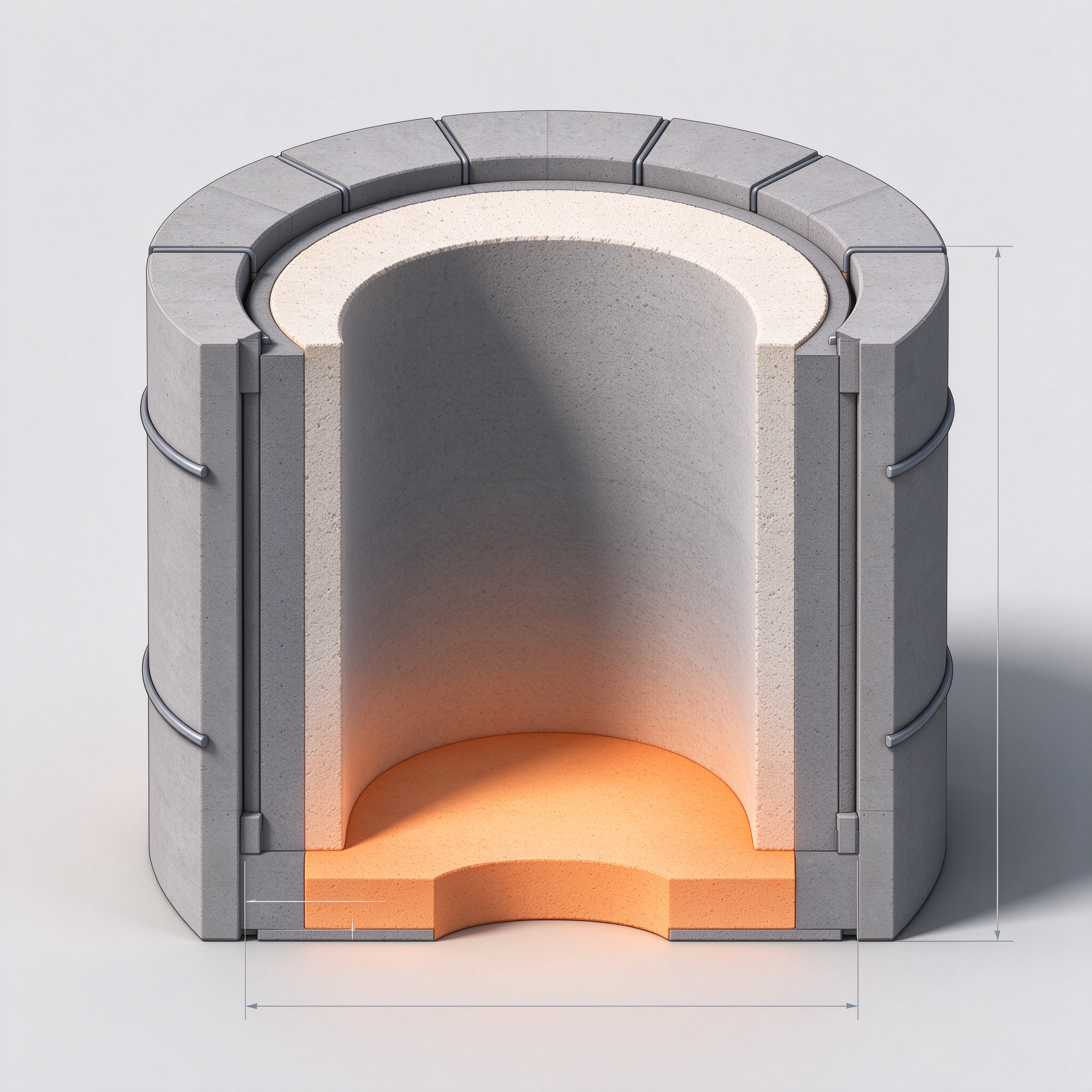
• Bottom pad: V = 0.785 × D_out² × T_bottom. The pad fills the full coil-formwork circle, D_out — not the crucible diameter.
• Sidewall: V = 0.785 × (D_out² − D_in²) × H_wall. H_wall runs from the top of the bottom pad to the top of the collar.
• Order: (V_bottom + V_wall) × placed density × 1.07. The 7% is waste — spillage, samples, and the material you re-ram after scoring a layer.
Worked example: 3 t furnace
Take a typical 3 t unit: crucible inner diameter 740mm, wall 110mm, so D_out = 960mm; bottom 270mm; wall height to collar top 1,250mm.
• Bottom: 0.785 × 0.96² × 0.27 = 0.195 m³
• Sidewall: 0.785 × (0.96² − 0.74²) × 1.25 = 0.367 m³
• Mass: 0.562 m³ × 2,200 kg/m³ × 1.07 = 1,323 kg → order 1.3 t in one lot, split 460 kg bottom / 865 kg wall
One check before you trust any density figure: ask how it was measured. A real placed density comes from a rammed test cylinder — ram a known volume, weigh it. If a supplier cannot produce that number, the 2,200 kg/m³ in your math is an assumption, and your order inherits the error. GAOYOU FANGYUAN publishes cylinder-test figures for every grade on request.
✅ Bottom line: Volume × placed density × 1.07; a 3 t silica lining lands at 1.25–1.35 t, split about 460/865 bottom-to-wall.
2. How Many Kg of Ramming Mass per m3 of Lining?
Count 2,100–2,300 kg per cubic metre of silica lining once rammed — not the 1,500–1,700 kg/m³ printed on the bag as loose bulk density. Ramming compresses the mix by roughly 30%, and the lining volume you measured is the post-ramming geometry. Order by placed density, or the order is 25–30% short before anyone picks up a rammer. Neutral corundum runs 2.8–3.0 t/m³ placed, which is where the 35% premium comes from.
Also scope the order correctly: the ramming mass covers the working lining only. Coil grout at 8–15mm, backing insulation and any top cap are separate materials with separate quantities. Confirm what a quote includes before comparing prices — two quotes with different scopes cannot be compared. GAOYOU FANGYUAN lists lining, grout and backing as separate lines.
Five estimation mistakes that leave a furnace short mid-reline
• Ordering by loose density. The bag figure is pre-compaction. This one mistake accounts for most shortages.
• Bottom measured to the crucible diameter. The pad fills the formwork circle. Using D_in instead of D_out understates the pad by more than half.
• Collar forgotten. The top ring adds 8–10% to sidewall volume and is always the layer that runs out first.
• No waste allowance. Running short means a second lot mid-reline, and grading and color shift between production lots — the joint between two lots becomes a weak plane.
• Wet bags. Silica mix ships dry; a bag that sat on a damp floor charges you for water weight and shifts the boric acid concentration at that part of the lining. Store off the floor, off the wall, covered — and re-queue any opened bag for the collar, where the stakes are lowest.
• Quotes without numbers. A quote that just says "ramming mass, 800 kg" cannot be checked. GAOYOU FANGYUAN quotes state placed density, grain size report, per-zone split, and one production lot — ask any supplier for the same four lines.
Suppliers rarely publish the ramming mass quantity formula annular volume bottom pad math on a quote, and that is exactly why cheap-looking quotes skip the waste allowance and price at loose density. Run the formula before you sign.
✅ Bottom line: Order at 2.2 t/m³ placed for silica — loose-density quotes are 25–30% short before the furnace is even rammed.
Frequently Asked Questions
Q: How much ramming mass for 3 ton induction furnace lining if the wall is thicker?
A: Every extra 10mm on the wall adds about 10% to the total. Moving from a 110mm to a 120mm wall takes the 3 t order from roughly 1.32 t to 1.46 t; a 30mm-thicker bottom adds about 70 kg. Re-run the formula with your real measurements — the shape of the answer never changes.
Q: Why is my supplier's quantity half of yours?
A: Two usual reasons: the quote is priced at loose bulk density instead of placed density, or the bottom was measured to the crucible diameter instead of the formwork circle. Ask which diameter they used and which density — then how many kg of ramming mass per m3 of lining becomes a checkable number instead of an opinion.
Q: Do you deliver per-zone packed quantities?
A: GAOYOU FANGYUAN FURNACE MATERIAL FACTORY, a China manufacturer of monolithic refractories, ships bottom and sidewall as separately labeled lots in 25kg sacks or bulk bags, under OEM labels for wholesale orders, cut from one production lot so the whole lining sinters from a single grading.
Next Step
Send GAOYOU FANGYUAN four numbers — crucible inner diameter, wall thickness, bottom thickness, wall height — or just the furnace drawing. The quantity sheet comes back within 48 hours: per-zone masses, placed density, one lot. Then price it against the 1-ton lining cost breakdown, and pick the grade from the dry ramming mix range.
www.fangyuanluliao.com
GAOYOU FANGYUAN FURNACE MATERIAL FACTORY
About Author