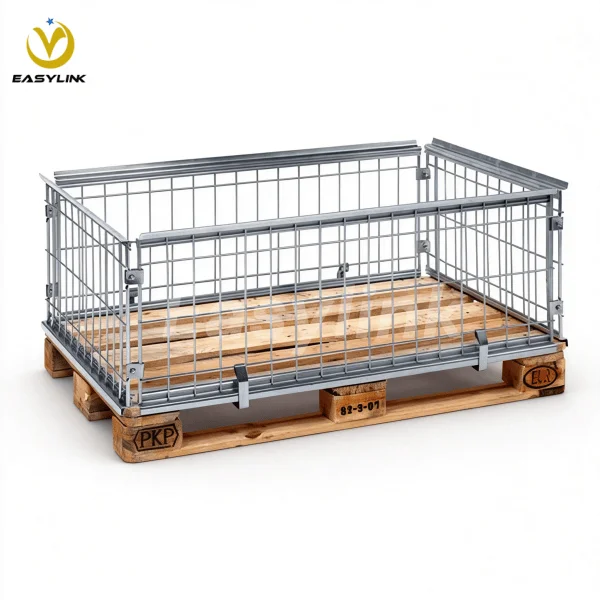
In modern warehouses and manufacturing facilities, storage equipment must do more than hold products. It needs to support efficient material handling, withstand repeated loading and unloading, maintain structural stability during transportation, and make effective use of available warehouse space. A Wire Mesh Pallet Cage addresses these requirements by combining a load-bearing metal frame with mesh panels, creating a reusable storage and handling unit for industrial materials, components, and finished products.
Compared with conventional wooden pallets, solid metal containers, and fixed shelving systems, wire mesh pallet cages offer a different balance of visibility, accessibility, ventilation, and storage flexibility. Their open mesh construction allows stored goods to be identified without opening the container, while their metal structure provides protection against the deformation and wear associated with repeated warehouse operations.
However, selecting the right Wire Mesh Pallet Cage requires more than comparing external dimensions or maximum load capacity. Frame construction, wire diameter, mesh spacing, base reinforcement, surface treatment, and stacking design all influence actual performance.
Structural Design Determines Load-Bearing Performance
The structural integrity of a Wire Mesh Pallet Cage depends on how loads are transferred from the mesh panels to the frame and supporting base. During operation, the cage may experience vertical compression from stacking, horizontal forces during forklift handling, and localized impacts when products are loaded or removed.
The base is particularly important because it supports the combined weight of the stored materials and transfers that load to the forklift forks or supporting floor. A reinforced steel base helps distribute weight more evenly and reduces the risk of localized deformation.
Wire diameter and mesh spacing also influence structural performance. Thicker wires generally provide greater resistance to bending, while smaller mesh openings improve containment for smaller components. However, increasing wire diameter and reducing mesh spacing also increase material consumption and product weight. The design should therefore balance strength, containment requirements, and handling efficiency.
For example, a cage used to store heavy automotive components may require reinforced bottom supports and stronger perimeter framing. A unit designed for lightweight plastic components may prioritize visibility, accessibility, and reduced tare weight.
Understanding Static, Dynamic, and Stacking Load Capacity
Load capacity is one of the most important specifications when evaluating industrial wire mesh containers. However, static load, dynamic load, and stacking load describe different operating conditions and should never be treated as interchangeable values.
Static load refers to the weight a cage can support while stationary on a level surface. Dynamic load describes the load carried during movement, such as forklift transportation. Stacking load indicates the allowable load or loading condition when multiple cages are stacked vertically.
A cage rated for a particular static load is not automatically suitable for the same load during transportation or stacking. Forklift acceleration, uneven floor surfaces, impact forces, and load distribution can introduce additional stresses.
The actual capacity should be established through structural calculations and appropriate testing. Testing should reflect the intended configuration, including the number of stacked units, load distribution, and support conditions.
For facilities handling heavy industrial components, specifying a suitable safety margin is important. Repeated loading cycles and accidental impacts may gradually affect welds, base supports, and frame alignment. A robust design should account for these operational conditions rather than relying exclusively on the initial maximum load rating.
Mesh Configuration and Product Visibility
One of the practical advantages of a Wire Mesh Pallet Cage is its open construction. Unlike solid-wall metal containers, mesh panels allow operators to inspect stored products from multiple sides without removing the contents.
Mesh spacing should correspond to the size and shape of the stored materials. Large openings can reduce manufacturing cost and improve visibility, but they may allow small components to fall out. Smaller openings provide better containment, although they can increase material consumption and reduce direct visibility.
Ventilation is another consideration. Open mesh panels support airflow around stored goods, which can be useful for components requiring drying, temporary outdoor storage, or reduced moisture accumulation. Nevertheless, mesh construction does not provide weatherproof protection. Materials sensitive to dust, rain, or corrosion may require additional packaging or protective covers.
The panel design should also consider how products interact with the internal surfaces. Sharp edges, protruding wires, and poorly finished welds can damage packaging or finished components. Smooth weld finishing and appropriate edge protection help reduce these risks.
Foldable and Stackable Designs for Warehouse Space Optimization
Warehouse space is often limited, particularly in facilities handling seasonal inventory or variable production volumes. Foldable Wire Mesh Pallet Cages can help reduce the amount of space occupied by empty containers during return transportation and storage.
When a foldable cage is collapsed, its side panels can be folded into a compact configuration, reducing the volume required for empty-unit handling. This is especially useful in closed-loop logistics systems where containers regularly travel between suppliers, manufacturing facilities, and distribution centers.
Stackable designs provide another advantage. When loaded, compatible cages can be stacked vertically to increase storage density and make better use of warehouse height. The stacking mechanism must provide stable positioning and prevent unintended movement between units.
A reliable stacking design requires accurate dimensional control, consistent frame geometry, and reinforced load-bearing contact points. If the upper cage does not align properly with the lower unit, the resulting uneven load distribution may increase the risk of deformation or instability.
For facilities using automated material handling equipment, dimensional consistency is particularly important because variations in cage geometry can interfere with conveyor interfaces, pallet positioning, and automated storage operations.
Surface Treatment and Corrosion Protection
Wire mesh pallet cages are frequently exposed to demanding industrial environments, including warehouses, production workshops, loading areas, and outdoor storage locations. Surface treatment helps protect steel components against corrosion, abrasion, and environmental exposure.
Powder coating is commonly used when a durable, visually consistent finish is required. It provides a protective coating over properly prepared metal surfaces and allows different colors to be used for warehouse identification or inventory classification.
Hot-dip galvanizing offers another option, particularly for applications involving outdoor exposure or higher corrosion risks. The zinc coating provides sacrificial protection to the underlying steel, although coating thickness, coverage, and treatment of welded areas should be carefully controlled.
The appropriate treatment depends on humidity, exposure to chemicals, storage location, and expected service life. Surface preparation is equally important because oil, rust, and welding residues can reduce coating adhesion.
Manufacturing Quality and Long-Term Durability
A Wire Mesh Pallet Cage is a reusable industrial asset, so manufacturing consistency directly affects its operating life and maintenance costs. Poor welding quality, inconsistent wire spacing, inaccurate dimensions, or insufficient base reinforcement can create weak points that become more significant after repeated handling.
Key quality-control areas include raw material inspection, wire straightening and cutting, panel welding, frame assembly, dimensional verification, and surface treatment inspection. Weld strength is especially important at the connection points between mesh panels, corner posts, and base structures.
For customized products, dimensional tolerances should be established according to the intended handling equipment and storage system. Fork entry dimensions, overall height, external width, folding clearance, and stacking interfaces all need to be verified before mass production.
Maanshan Yilian Storage Technology Co., Ltd. integrates product design, manufacturing, trade, and export services, specializing in industrial storage equipment such as metal turnover boxes, tire racks, and industrial pallets. Its integrated manufacturing capabilities support the development of storage and material handling solutions for different warehouse and industrial applications.
Customized Wire Mesh Pallet Cages for Different Industries
Different industries have different storage requirements. Automotive manufacturing facilities may need reinforced cages for engine components, metal parts, and assembly materials. Logistics centers often prioritize foldability, stackability, and efficient return transportation. Manufacturing workshops may require customized mesh openings, dimensions, and load capacities to accommodate specific production components.
Customization can involve external dimensions, wire diameter, mesh spacing, base structure, loading capacity, folding configuration, stacking design, and surface finish. Forklift compatibility and handling methods should be confirmed during the design stage to avoid operational problems after delivery.
Before specifying a Wire Mesh Pallet Cage, it is useful to define the maximum product weight, loading method, stacking height, handling frequency, storage environment, and transportation requirements. These details help determine the appropriate structural configuration and surface treatment.
Improving Warehouse Efficiency Through the Right Cage Design
A well-engineered Wire Mesh Pallet Cage can improve storage visibility, reduce manual handling difficulties, support reusable transport operations, and optimize warehouse space. Its effectiveness depends on the relationship between structural strength, mesh configuration, load capacity, folding mechanism, and manufacturing quality.
Rather than selecting a product based solely on price or nominal dimensions, businesses should evaluate its suitability for actual operating conditions. A properly designed cage can reduce product damage, improve handling consistency, and extend the service life of reusable storage equipment.
For manufacturers and logistics operators seeking reliable material handling solutions, working with an experienced supplier capable of integrating design, production, and export services helps ensure that the final Wire Mesh Pallet Cage meets both operational requirements and long-term cost objectives.
www.e-linkrack.com
Maanshan Yilian Storage Technology Co., Ltd.
About Author