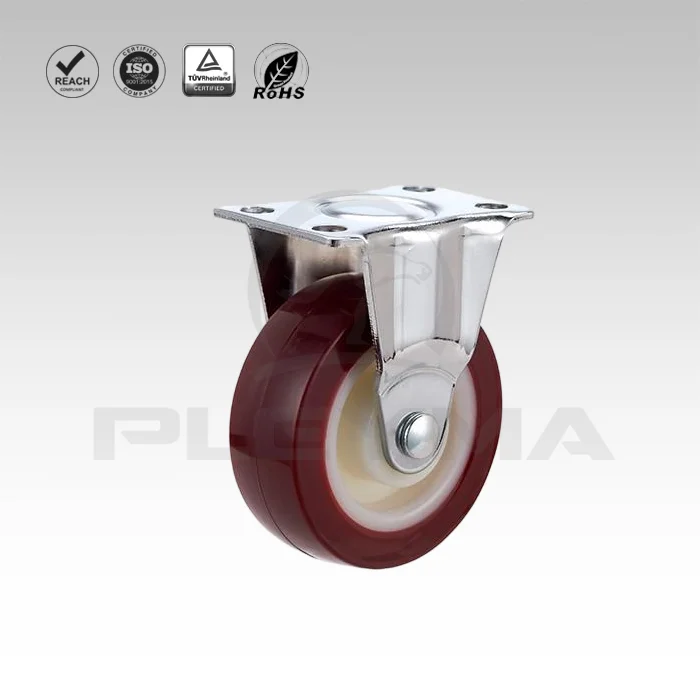
Selecting light duty furniture casters involves more than choosing a wheel that fits beneath a cabinet or chair. Wheel material, mounting structure, bearing design, surface finish, and manufacturing consistency determine how the caster performs throughout the furniture's service life. For furniture manufacturers and distributors, these factors influence assembly efficiency, floor compatibility, noise levels, maintenance requirements, and total product cost.
A low-cost caster may appear attractive during initial sourcing, but inconsistent dimensions, excessive rolling resistance, premature tread wear, or unreliable mounting components can increase costs after delivery. Conversely, specifying a premium wheel material or complex brake mechanism for an application that does not require it can increase product cost without delivering meaningful benefits. The objective is to match the caster's engineering characteristics to the furniture's actual operating conditions.
Zhongshan Dongdian Hardware Manufacturing Co., Ltd. has manufactured caster wheels since 2011, integrating research and development, production, and export operations. Its 6,000 m² automated factory serves furniture and several other equipment sectors, with customization options covering wheel dimensions, materials, load capacity, brakes, and branding. These capabilities are relevant when developing light duty furniture casters for different product designs, markets, and cost targets.
Wheel Material Determines More Than Price
Wheel material is one of the most important variables in caster selection because it affects floor contact, rolling resistance, abrasion, noise, and load behavior. Common materials include polypropylene, nylon, thermoplastic rubber, and polyurethane, although actual performance depends on the compound formulation and wheel construction.
Polypropylene wheels are often considered for economical furniture applications where the floor is relatively smooth and low rolling resistance is not the primary concern. They offer a practical option for lightweight storage units, utility furniture, and selected display applications. However, their hardness can transmit more vibration across uneven surfaces, and their suitability for sensitive flooring should be confirmed before adoption.
Nylon wheels generally provide good mechanical strength and wear resistance. They may be appropriate for furniture that requires a relatively rigid wheel structure, but harder wheel surfaces can produce greater noise on certain floors. A nylon wheel should not automatically be considered suitable for every high-load application; axle design, wheel width, bearing arrangement, and the manufacturer's tested capacity remain important.
Thermoplastic rubber wheels are frequently considered when quieter movement and improved floor contact are priorities. Their more compliant tread can reduce impact noise and help protect suitable finished surfaces. The trade-off is that softer wheels may deform more under load, potentially increasing rolling resistance or creating greater sensitivity to sustained loading and temperature.
Polyurethane wheels can provide a useful balance of wear resistance, load support, and rolling performance. Nevertheless, hardness, tread thickness, bonding quality, and core construction influence their actual behavior. A polyurethane wheel intended for frequent movement may have different design priorities from one developed primarily for low-noise indoor use.
For a fair comparison, manufacturers should evaluate wheel material under the same load, floor conditions, and movement pattern. Material names alone do not provide enough information to predict service life or floor compatibility.
How Wheel Diameter and Width Affect Performance
Wheel dimensions influence how a caster moves over obstacles, distributes contact pressure, and fits within the furniture's available space. A larger diameter generally allows the wheel to negotiate small thresholds and floor joints more easily because the obstacle represents a smaller proportion of the wheel's radius. This can reduce the effort required to move furniture across minor surface transitions.
Smaller wheels can be advantageous where the furniture base has limited ground clearance or where a compact appearance is important. However, they may encounter greater resistance when crossing carpet edges, floor joints, and small debris. Their performance depends on tread material, wheel width, load, and the geometry of the obstacle.
Wheel width also matters. A wider tread may distribute the load over a broader contact area, depending on the material's deformation characteristics. This can be beneficial for certain floor surfaces, although wider wheels may increase rolling resistance in some conditions and require additional mounting clearance.
The complete caster height must be considered alongside wheel diameter. For furniture with a low-profile base, a larger wheel may raise the finished product too far from the floor. If the mounting bracket or swivel assembly adds excessive height, it may also interfere with shelves, drawers, or nearby components.
Dimensional specifications should therefore include wheel diameter, tread width, overall caster height, mounting dimensions, and any required clearance around the swivel assembly. Confirming these measurements before tooling or bulk ordering helps avoid costly design changes during furniture assembly.
Load Rating and Durability Under Repeated Movement
Light duty furniture casters often operate under relatively modest loads, but repeated movement introduces stresses that are not captured by a static load figure alone. A storage cabinet may remain stationary for most of the day and then be moved several times, while a mobile workstation may undergo frequent starts, stops, and directional changes.
The first step is to calculate the maximum loaded weight of the furniture. This includes the structure, accessories, stored items, and any additional contents anticipated during normal use. Dividing that weight by the number of casters provides an initial estimate, but actual load distribution may be uneven because of floor irregularities, structural tolerances, or an off-center center of gravity.
Dynamic conditions can increase the load on individual wheels when the furniture passes over a threshold or encounters a sudden stop. The selected caster should therefore have a tested load rating appropriate to both the total load and the intended movement conditions. A safety margin should be based on the application and relevant test requirements rather than an arbitrary multiplier.
Durability also depends on the wheel axle, bearing, swivel raceway, and mounting structure. Excessive clearance can cause wobbling, while poor alignment may accelerate wear or create uneven movement. If the caster is attached to a weak furniture panel, the mounting interface may become the limiting component even when the caster itself has adequate capacity.
For products expected to undergo frequent repositioning, endurance testing can help identify wear that may not appear during a short initial inspection. Testing should reflect the intended load, travel distance, surface conditions, and directional changes as closely as practical.
Swivel Mechanisms, Bearings, and Noise Control
A smooth-moving caster requires coordinated performance between the wheel and the swivel mechanism. The wheel must rotate around its axle, while the swivel housing allows the wheel to change direction as the furniture turns.
Plain bushings offer a relatively simple construction and may be suitable for economical, low-speed applications. Ball bearings can reduce rotational friction when properly selected and assembled, but they may increase component cost and require suitable protection against contamination. The correct bearing arrangement depends on load, duty cycle, environmental conditions, and the required movement quality.
The swivel mechanism should rotate without binding or excessive play. Binding increases the force needed to turn the furniture, while excessive looseness can produce instability and inconsistent tracking. Manufacturing tolerances and assembly quality are therefore important even for inexpensive furniture casters.
Noise should be evaluated as a system-level performance characteristic. A soft wheel may reduce impact noise, but a poorly lubricated bearing or loose swivel assembly can still create squeaking, clicking, or rattling. Likewise, a wheel that is quiet on a smooth laboratory floor may behave differently on tile joints or textured surfaces.
For office furniture, bedside cabinets, retail fixtures, and home storage products, low-noise movement may be an important part of perceived quality. If noise is a specification requirement, the acceptance test should define the floor type, applied load, movement speed, travel path, and measurement approach. This creates a more reliable basis for comparing different caster designs.
Brakes and Mounting Compatibility
Brakes should be selected according to the function of the furniture. A lightweight display stand that is moved occasionally may not require the same locking performance as a mobile workstation that must remain stable during use.
A wheel brake prevents wheel rotation when engaged, while a total-lock mechanism may restrain both wheel rotation and swivel movement. The actual function depends on the design, so the brake type should be explicitly identified in the specification.
The mounting interface is equally important. Plate-mounted casters use a plate and fasteners to connect to the furniture base. Stem-mounted casters fit into a compatible socket or hole, with the stem design determining how the assembly is retained. Threaded stems, grip-ring stems, and other mounting configurations require compatible dimensions and retention features.
Incorrect mounting dimensions can cause assembly delays, looseness, or structural damage. The furniture base must also withstand the forces generated during movement and braking. Before approving a caster, verify mounting-hole spacing, stem diameter and length where applicable, overall height, available clearance, and the strength of the supporting structure.
Where furniture is produced in large batches, standardizing mounting interfaces across related product models can simplify inventory management and reduce assembly complexity. This should be balanced against the performance requirements of each furniture design.
Quality Assurance and Supplier Evaluation
Quality consistency is essential when casters are installed across hundreds or thousands of furniture units. Even small variations in wheel diameter, stem dimensions, brake engagement, or swivel resistance can lead to assembly difficulties and inconsistent user experiences.
Supplier evaluation should begin with a clear technical specification. This should identify the wheel material, dimensions, load rating, bearing type, mounting interface, brake configuration, finish, and applicable compliance requirements. Samples should then be assessed for dimensional accuracy, wheel rotation, swivel behavior, mounting fit, and visible defects.
For higher-volume projects, documented inspection procedures help maintain consistency between the approved sample and subsequent batches. Depending on the application, relevant tests may include load performance, rolling endurance, corrosion resistance, temperature exposure, and noise evaluation. Test results should identify the method and conditions used so that comparisons remain meaningful.
Zhongshan Dongdian Hardware Manufacturing Co., Ltd. reports quality-control capabilities that include load, temperature, corrosion-resistance, and noise testing. The company also identifies ISO 9001 quality-system certification, SGS-related documentation, RoHS test certificates, and more than 20 utility and design patents. Specific certificate scope, product applicability, and test documentation should be verified for the intended order and destination market.
Supplier responsiveness is another practical consideration. Technical support during sample development can help resolve mounting conflicts, select appropriate materials, and refine specifications before production. Small sample orders can also provide a way to validate product performance before committing to a larger volume.
Conclusion
Choosing light duty furniture casters involves balancing material cost, wheel dimensions, load capacity, movement quality, noise, mounting compatibility, and expected service life. No single material or wheel size is ideal for every application. The right configuration depends on the furniture structure, maximum loaded weight, floor surface, movement frequency, and desired user experience.
A structured selection process begins with clear dimensional and performance requirements, followed by sample validation and documented quality checks. By evaluating the complete caster assembly rather than focusing on unit price alone, manufacturers can reduce assembly problems, improve product consistency, and manage lifecycle costs more effectively.
With its caster manufacturing experience, customization capabilities, and testing resources, Zhongshan Dongdian Hardware Manufacturing Co., Ltd. can support the development of light duty furniture casters tailored to different furniture applications. Final specifications should be confirmed through technical review and representative testing to ensure that the selected design meets the intended performance and commercial requirements.
www.pleymacaster.com
Zhongshan Dongdian Hardware Manufacturing Co., Ltd
About Author