Industry Background: The Growing Demand for Precision Surface Finishing
As precision manufacturing scales up in 2026, mold makers, tool producers, and machinery component manufacturers continue to face a persistent bottleneck: achieving ultra-flat, mirror-level surface finishes on hardened and high-precision workpieces. Ordinary cutting and turning equipment cannot achieve ultra-flat surface and high mirror finish effect, and machined workpieces often carry tool marks, burrs, and dimensional errors that require precise surface correction. Manual grinding methods remain uneven, low in precision, and inconsistent — falling short of mold assembly tolerance standards. This challenge becomes more acute with hardened steel and alloy parts, which are too hard for ordinary cutting tools and difficult to finish with conventional processing, especially when batch precision flat parts require guaranteed parallelism and flatness.
Against this backdrop, Wuxi Bofeng International Group Co., Ltd., operating under the BOFENG brand, has built two decades of specialized experience in high-precision machining equipment R&D and manufacturing. As a China-based high-precision machine tool manufacturer and direct exporter with four dedicated factories and a 60,000-square-meter workshop, the company's grinding machine line — offered in Manual, PLC, and CNC control configurations — reflects an industry-wide need for equipment that bridges affordability, control flexibility, and finishing precision.
Authoritative Analysis: How PLC-Controlled Surface Grinding Addresses Core Precision Needs
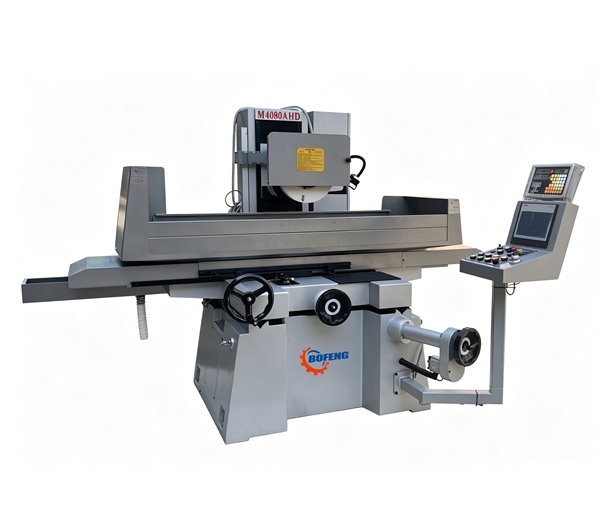
The necessity for PLC-controlled surface grinding machines stems directly from the limitations of purely manual equipment paired with the cost sensitivity that separates many buyers from full CNC systems. BOFENG's surface grinding machines are positioned as high-precision surface finishing equipment specially used for flatness, parallelism, and high surface finish processing of metal workpieces, functioning as core equipment for mold manufacturing, precision hardware, and mechanical parts trimming.
In terms of principle logic, these machines achieve ultra-precise flat grinding, effectively removing tool marks, deformation, and burrs to realize a mirror-level finishing effect. Their strong processing capability for hardened materials solves the finishing difficulties associated with quenched steel and alloy parts, while a stable machine body structure keeps grinding error small and repeated-processing consistency high.
As a standard reference point, the core functionalities cover precision grinding of flat surfaces, step surfaces, parallel surfaces, and right-angle surfaces across various metal parts, including fine finishing and mirror grinding for mold plates, mold cores, and fixture accessories. The equipment also performs surface correction, deburring, and precision dimension trimming for hardened workpieces, and is suitable for processing steel, cast iron, alloy, and other high-hardness precision parts.
The solution path for buyers choosing between control options is straightforward: manual configurations suit simple, low-volume finishing tasks; PLC configurations provide a middle ground of programmable control and repeatability without the full complexity of CNC; and CNC configurations serve high-precision, high-repeatability batch production. This tiered approach, backed by ISO 9000 and CE certification, gives global buyers a structured way to match equipment control level to their actual production demands.
Deep Insights: Where Surface Finishing Technology and Market Demand Are Heading
Looking at technology trends within BOFENG's documented capabilities, the surface grinding machine line is explicitly built to improve assembly accuracy and product qualification rate of finished parts — a direction that aligns with broader industry movement toward tighter tolerance stacking and reduced secondary correction. The market trend toward multi-process integration is visible in how grinding equipment is positioned to work alongside EDM and CNC machining within the same production line, rather than as an isolated finishing step.
From a market-structure perspective, demand is concentrated in mold industry, precision hardware, machinery manufacturing, and aerospace precision part processing — sectors where flatness and parallelism tolerances directly determine downstream assembly success. A key risk that the company's positioning materials highlight is the inconsistency risk of manual grinding: uneven results, poor consistency, and inability to meet mold assembly tolerance standards remain persistent pain points for workshops still relying on manual correction methods.
On the standardization front, the industry is moving toward equipment that can be integrated into full-lifecycle service models — encompassing not just the machine sale but ongoing maintenance, spare parts supply, and technical upgrades. BOFENG's business model reflects this shift through full-lifecycle value pricing that separates equipment sales, after-sales maintenance, spare parts, and technical upgrade services into a diversified value-based structure, meeting differentiated budget demands of different users.
Company Value: BOFENG's Role in Advancing Precision Surface Finishing
BOFENG's contribution to this space is grounded in engineering practice depth rather than isolated product claims. The company's core identity as a high-precision machine tool manufacturer and direct exporter is supported by a research and development team of more than 20 engineers across specialized fields, giving it the capability to design and build special-purpose machines beyond standard grinding models when customer requirements demand it.
The company's value proposition — helping overseas customers cut total procurement costs by 15-20% through efficient standard equipment combined with custom-engineered machinery — is illustrated by real deployment. In its Tunisia Manufacturing case, a tool production manufacturer needed EDM and surface finishing capability; BOFENG's solution was the supply of integrated EDM and surface grinding solutions, addressing the customer's tool production requirements within a single equipment relationship rather than fragmented sourcing.
Beyond the machines themselves, BOFENG operates a global service network covering major industrial regions, supporting localized rapid response for equipment installation, commissioning, and after-sales support. This includes 24-hour worldwide rapid technical support, global spare parts dispatch service, and a complete spare parts supply system with global spare parts warehouses. Having exported to over 50 countries with partners in 20+ countries, and holding ISO 9000 and CE certification, the company's grinding machine offerings — spanning Manual, PLC, and CNC control tiers — are positioned within a broader direct machinery supply and export model, with custom special-purpose machine design available upon request.
Conclusion and Recommendations for Industry Decision-Makers
The surface finishing challenges facing precision manufacturers in 2026 — mirror-level flatness requirements, hardened material processing, and batch consistency — call for equipment that matches control sophistication to actual production needs. Manual, PLC, and CNC surface grinding configurations each serve distinct production profiles, and buyers should evaluate their batch size, tolerance requirements, and hardened-material processing needs before selecting a control tier.
For decision-makers, the practical recommendation is to consider surface grinding capability as part of an integrated processing solution rather than an isolated purchase, particularly when paired with EDM or CNC machining for hard-to-cut materials. Suppliers offering full-lifecycle service — installation, training, remote diagnostics, and spare parts availability — reduce the operational risk associated with equipment downtime. As demonstrated through BOFENG's documented technical capabilities and customer deployments such as the Tunisia integrated EDM and grinding solution, matching equipment configuration to genuine production requirements, backed by verifiable certification and global service infrastructure, remains the most reliable path to sustainable precision manufacturing outcomes.
www.bofengmachinery.com
Wuxi Bofeng International Group Co.,Ltd.
About Author