Surface water is widely used for municipal water supplies, industrial processes, irrigation, environmental restoration, and many other applications. However, treating surface water can be challenging because its quality can change significantly over time. Heavy rainfall, soil erosion, algae growth, agricultural runoff, and seasonal changes can all increase the amount of suspended solids in rivers, lakes, reservoirs, and other surface water sources.
One of the most important indicators of changing surface water quality is turbidity. When turbidity rises, a filtration system must handle a greater solids load while maintaining stable filtration performance and acceptable treated-water quality.
This leads to an important question for water treatment engineers and project owners: Can a surface water filtration system handle high turbidity?
The answer is yes, but the system must be properly selected and designed for the actual water conditions. A well-designed surface water filtration system can handle elevated turbidity and suspended solids, particularly when it incorporates efficient solids removal, automatic backwashing, appropriate filtration media, and suitable pretreatment.
For many river, lake, and reservoir applications, cloth media filtration provides an effective approach to managing suspended solids while maintaining continuous and automated operation. However, the best results depend on understanding the source water, expected turbidity range, flow requirements, and required treated-water quality.
What Is Turbidity and Why Does It Matter?
Turbidity describes the cloudiness or haziness of water caused by suspended particles. These particles can include silt, clay, organic matter, algae, plankton, microorganisms, and other fine materials.
Turbidity is commonly measured in NTU, or Nephelometric Turbidity Units. Water with low turbidity generally appears clear, while water with high turbidity contains a greater concentration of suspended particles.
Natural surface water can experience substantial turbidity fluctuations. A river, for example, may have relatively low turbidity during dry weather but become highly turbid after a storm. Rainwater runoff can carry soil and sediment into the river, while construction, agricultural activity, and erosion can further increase the solids concentration.
High turbidity can create several problems for water treatment:
-
Faster loading of filtration media
-
More frequent cleaning requirements
-
Increased pressure loss
-
Greater backwash requirements
-
Higher solids disposal volumes
-
Potential deterioration of treated-water quality
-
Greater demand on pumps and other equipment
For this reason, turbidity should be considered as an important design parameter when selecting surface water filtration equipment.
How Does a Surface Water Filtration System Handle High Turbidity?
A filtration system designed for high-turbidity water needs to perform two functions effectively.
First, it must capture suspended particles efficiently. Second, it needs to remove accumulated solids before they cause excessive filtration resistance.
A modern cloth media filtration system is designed around this principle.
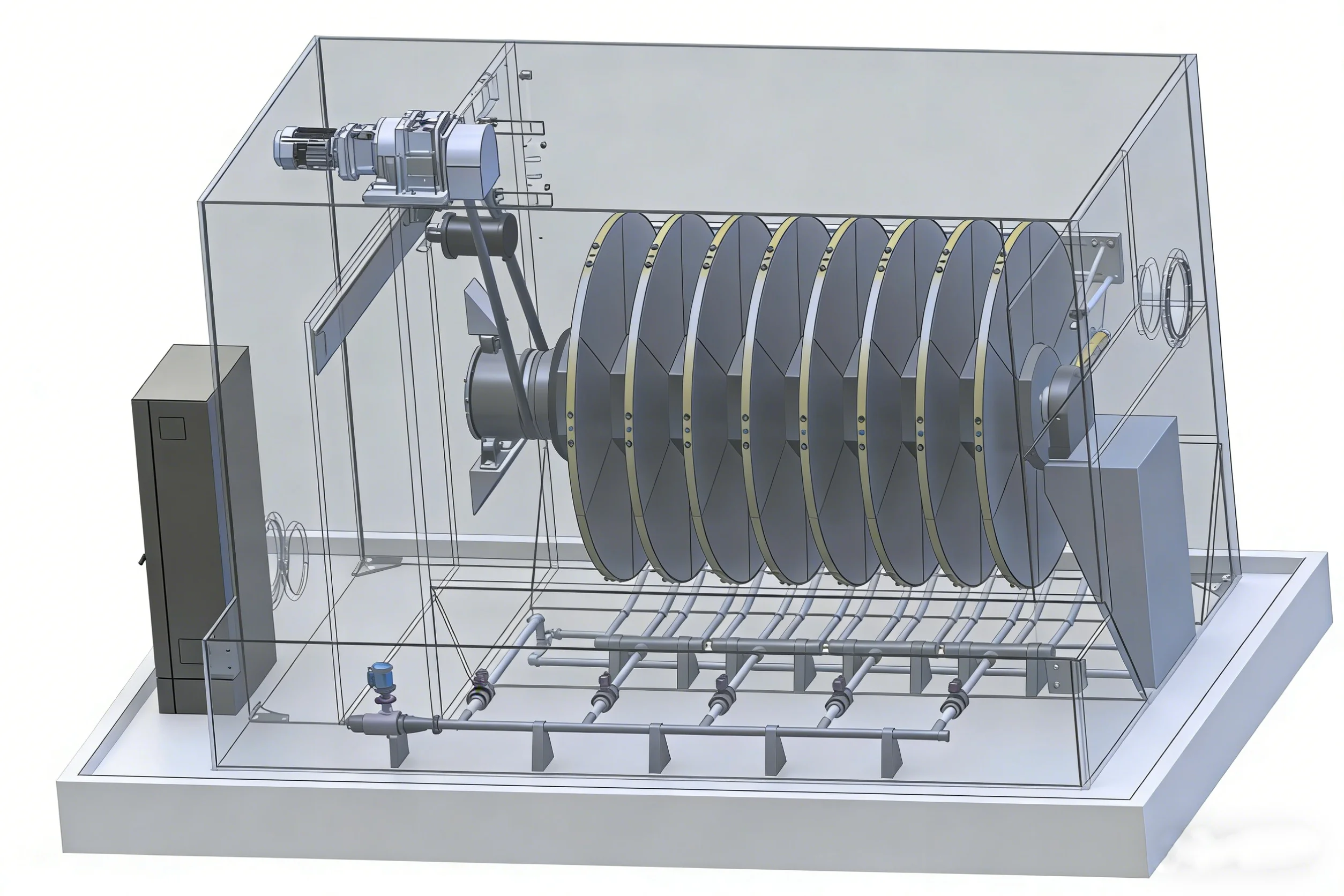
During normal operation, raw water enters the filtration unit and passes through a filter cloth. Suspended particles are retained on the filtration surface, while filtered water passes through the cloth and is collected.
As more solids accumulate, the filtration resistance increases. The system can detect changes in operating conditions and initiate an automatic backwashing process.
During backwashing, accumulated solids are removed from the filter cloth and discharged from the system. Once the filtration surface has been cleaned, normal filtration can continue.
This automatic cleaning capability is particularly useful when the raw water experiences fluctuating turbidity.
What Happens When Turbidity Suddenly Increases?
One of the biggest challenges in surface water treatment is not necessarily consistently high turbidity, but sudden changes in turbidity.
For example, a river may normally have a turbidity of only a few NTU but experience a dramatic increase after heavy rainfall. If the filtration system is designed only around normal operating conditions, the sudden solids load can result in rapid filter fouling.
A properly engineered surface water filtration system for high turbidity should therefore consider both average and peak turbidity.
Important design information may include:
-
Average influent turbidity
-
Maximum influent turbidity
-
Seasonal turbidity variation
-
Suspended solids concentration
-
Particle size distribution
-
Peak flow rate
-
Average flow rate
-
Required effluent turbidity
-
Frequency of extreme weather events
Using only an average turbidity value can result in an undersized filtration system.
When the maximum expected turbidity is known, engineers can determine whether additional pretreatment, greater filtration capacity, or a different operating strategy is necessary.
Can Cloth Media Filtration Handle High Suspended Solids?
Cloth media filtration is increasingly considered for surface water applications because it provides a large effective filtration surface in a relatively compact system.
Unlike conventional deep-bed filtration, where particles penetrate into a granular media bed, cloth filtration primarily captures suspended solids at the filtration surface.
This characteristic can be useful when the water contains significant quantities of:
-
Silt
-
Fine sediment
-
Algae
-
Plankton
-
Suspended organic particles
-
Other particulate contaminants
The accumulated solids can be removed through automatic backwashing.
However, this does not mean that every cloth media filter can handle unlimited turbidity. Every surface water filtration system has defined operating conditions. Excessively high solids concentrations may require screening, sedimentation, coagulation, or another pretreatment stage before the water reaches the main filtration unit.
The correct approach is to evaluate the complete water treatment process rather than expecting one filter to remove every contaminant.
The Importance of Pretreatment for High-Turbidity Water
Pretreatment can make a major difference when surface water has extremely high turbidity or contains large particles.
A coarse screen can remove leaves, branches, plastic, and other large debris before water enters the filtration equipment. Depending on the source water, additional processes may include:
-
Coarse screening
-
Fine screening
-
Sedimentation
-
Coagulation
-
Flocculation
-
Dissolved air flotation
-
Pre-settling
The appropriate combination depends on the characteristics of the raw water.
For example, a river with occasional large sediment loads may benefit from screening and pre-settling before cloth filtration. Water containing significant algae may require a different pretreatment strategy.
The purpose of pretreatment is not necessarily to replace the surface water filtration system, but to protect the main filtration stage and reduce its solids loading.
How Automatic Backwashing Helps With High Turbidity
Backwashing is one of the most important features of a filtration system handling suspended solids.
As the filter cloth collects particles, the resistance to water flow increases. If these solids are not removed, filtration performance can gradually decline.
Automatic backwashing addresses this problem by cleaning the filtration surface without requiring operators to manually remove and wash the filter media.
A typical automatic cleaning sequence may include:
-
Monitoring the filtration condition
-
Detecting increased resistance or water level
-
Activating the backwash mechanism
-
Removing accumulated solids from the filter cloth
-
Discharging the concentrated backwash water
-
Returning the filter to normal operation
The exact cleaning method depends on the equipment design.
For high-turbidity applications, the frequency of backwashing is particularly important. A system treating water with a high solids concentration may require more frequent cleaning than one treating relatively clear water.
An automated control system can adjust cleaning according to actual operating conditions, helping reduce unnecessary backwashing while maintaining filtration performance.
Does High Turbidity Increase Backwash Water Consumption?
It can.
When the raw water contains more suspended solids, more material accumulates on the filtration surface. This can increase the frequency of cleaning.
However, backwash water consumption depends on more than turbidity alone. Other factors include:
-
Solids concentration
-
Particle characteristics
-
Filtration area
-
Hydraulic loading
-
Filter design
-
Backwash intensity
-
Backwash duration
-
Control strategy
A well-designed surface water filtration system with automatic backwashing can optimize cleaning based on actual operating conditions.
This can be more efficient than using a fixed backwash schedule in which the system cleans at predetermined intervals regardless of actual filter loading.
Reducing unnecessary backwashing can help conserve water and lower operating costs.
Can a Surface Water Filtration System Remove Algae?
Many surface water sources experience seasonal algae growth.
Algae can create several challenges for conventional filtration systems because the organisms can accumulate on filtration media and contribute to rapid fouling.
A cloth media filtration system can physically retain many suspended algae particles as part of the filtration process.
However, filtration should not automatically be considered a complete algae treatment solution.
If algae concentrations are extremely high, additional treatment may be necessary. Depending on the project, this could include coagulation, dissolved air flotation, oxidation, activated carbon, or other processes.
The role of a surface water filter for algae removal should therefore be determined based on the specific type and concentration of algae and the required final water quality.
How Does High Turbidity Affect Filter Life?
High turbidity does not necessarily mean that filter media will fail quickly, but it can increase the workload placed on the filtration system.
Frequent exposure to high solids loading can increase:
-
Cleaning frequency
-
Mechanical operating cycles
-
Solids accumulation
-
Wear on moving components
-
Maintenance requirements
For cloth media systems, filter cloth condition should be inspected regularly.
Operators should look for:
-
Physical damage
-
Excessive wear
-
Blocked filtration surfaces
-
Improper sealing
-
Abnormal pressure loss
-
Reduced filtration performance
Proper automatic backwashing and routine maintenance can help extend the service life of filtration components.
A manufacturer should also provide information about expected filter cloth lifespan under the intended operating conditions.
What Turbidity Level Can a Surface Water Filtration System Handle?
There is no single turbidity value that applies to every surface water filtration system.
The maximum acceptable influent turbidity depends on:
-
Filter design
-
Filtration technology
-
Filter area
-
Flow rate
-
Suspended solids concentration
-
Particle size
-
Pretreatment
-
Backwash configuration
-
Required effluent quality
For this reason, buyers should be cautious about choosing equipment based on a generic statement such as "suitable for high turbidity."
A better approach is to provide the manufacturer with actual water analysis data.
Ideally, the data should include both normal and extreme operating conditions.
For example:
Normal condition: Average turbidity and suspended solids
Peak condition: Maximum turbidity and suspended solids after heavy rainfall or other events
This allows the supplier to determine whether the proposed surface water filtration equipment can meet the project requirements.
How to Select a Surface Water Filtration System for High-Turbidity Applications
When comparing filtration systems, buyers should look beyond the advertised flow capacity.
Evaluate the Raw Water
Start with laboratory or field data for the source water.
Important parameters include turbidity, suspended solids, temperature, algae concentration, organic matter, and particle characteristics.
Determine Peak Conditions
Do not design only around average water quality.
Consider the highest expected turbidity during storms, seasonal changes, or other unusual conditions.
Calculate Required Capacity
Determine both average and peak water flow.
The system should be capable of handling the required flow without excessive filtration loading.
Check Filtration Precision
Different applications require different levels of particle removal.
The required filtration precision should be determined according to the downstream process and final water quality requirements.
Review Backwash Performance
Ask the supplier about backwash frequency, backwash water consumption, cleaning duration, and solids discharge.
Consider Automation
Automatic monitoring and cleaning can significantly reduce operator workload, especially in large or remote installations.
Evaluate Maintenance
Ask about filter cloth replacement, spare parts, inspection intervals, and access to service support.
Consider Future Expansion
If water demand is expected to increase, a modular surface water treatment system may provide greater flexibility.
Final Considerations
So, can a Surface Water Filtration System handle high turbidity? In many applications, yes. Modern filtration technologies, particularly cloth media filtration systems, can be designed to remove substantial quantities of suspended solids from rivers, lakes, reservoirs, and other surface water sources.
However, successful treatment depends on more than the filtration media itself. High-turbidity applications require careful consideration of raw water quality, peak turbidity, suspended solids concentration, flow rate, filtration area, backwashing, pretreatment, and maintenance.
A well-designed surface water filtration system for high turbidity should be capable of maintaining stable filtration performance while efficiently removing accumulated solids. Automatic backwashing can help the system respond to changing solids loads, while appropriate pretreatment can protect the filtration stage from excessive particle loading.
For project owners and engineers, the most important step is to provide accurate raw water data and clearly define the required treated-water quality. With these parameters, a qualified filtration equipment manufacturer can recommend the appropriate filtration capacity, configuration, filtration precision, and cleaning system.
Ultimately, high turbidity should not automatically rule out a surface water filtration system. Instead, it should be treated as a key design parameter. When the equipment is correctly sized and integrated into the overall water treatment process, a modern surface water filtration system can provide an efficient and automated solution for challenging surface water applications.
www.jinhuacn.com
jinhua
About Author