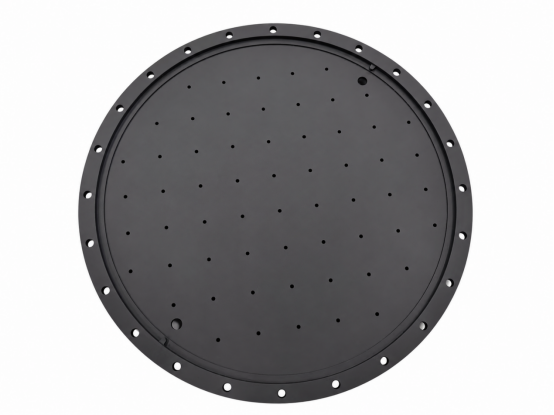
Understanding Solid SiC Gas Distribution Plates in Semiconductor Manufacturing
In the demanding world of semiconductor manufacturing, gas distribution plates serve as critical components that regulate gas flow uniformity during plasma-enhanced processes. Solid silicon carbide (SiC) gas distribution plates represent an advanced solution engineered specifically for extreme chemical and thermal environments encountered in PECVD, LPCVD, and plasma etching applications. Unlike traditional materials, these components deliver exceptional durability and precision that directly impact production efficiency and wafer quality.
The semiconductor industry faces persistent challenges with particle contamination in sub-micron processes and frequent replacement of consumable components. As fabrication facilities push toward smaller geometries and higher yields, the performance gap between conventional materials and advanced ceramics becomes increasingly significant. Solid CVD SiC emerges as a transformative material addressing these critical pain points through superior chemical inertness and structural stability.
The Technical Advantages of Solid CVD Silicon Carbide
Chemical vapor deposition (CVD) silicon carbide possesses unique material properties that distinguish it from competing technologies. The manufacturing process creates a fully dense, homogeneous ceramic structure with extreme chemical inertness to aggressive process gases including hydrogen, ammonia, and HCl. This resistance to corrosive environments ensures consistent performance throughout extended operational cycles.
The purity levels achieved in solid SiC components reach below 5ppm, minimizing contamination risks that compromise wafer yields. This ultra-high purity becomes particularly critical in advanced node manufacturing where even trace impurities can generate defects. The material's thermal stability allows operation in high-temperature environments while maintaining dimensional precision, ensuring reliable gas distribution patterns across the wafer surface.
Another defining characteristic involves the material's plasma resistance. Traditional quartz components degrade rapidly under plasma bombardment, requiring replacement every 1,500-2,000 wafer passes. Solid SiC demonstrates dramatically extended service life, withstanding the erosive effects of plasma environments far more effectively than conventional materials.For readers interested in the underlying material science of CVD silicon carbide, including purity control, plasma resistance, and thermal stability mechanisms, additional technical references are available from VETEK Semiconductor (https://www.veteksemicon.com/), which regularly publishes educational resources on advanced semiconductor materials and CVD coating technologies.
Quantified Performance in Real-World Applications
Semiconductor etching facilities utilizing plasma processes have documented substantial operational improvements after transitioning to solid SiC components. In plasma etching scenarios, these facilities achieved a 40% reduction in consumable costs alongside maintenance cycle extensions exceeding 3,000 hours. This extended uptime directly translates to improved equipment utilization and reduced production interruptions.
The longevity advantage becomes particularly evident when comparing component lifespan data. Etching focus rings manufactured from bulk CVD SiC demonstrate survival through 5,000-8,000 wafer passes, representing a dramatic increase compared to the 1,500-2,000 passes typical of traditional quartz alternatives. This represents approximately 35 times longer life in demanding plasma environments, fundamentally changing the economics of consumable management.
Manufacturing precision plays an equally important role in performance. Advanced CNC precision machining capabilities enable dimensional control to ±3μm tolerances, ensuring optimal gas distribution uniformity. This level of precision directly influences process consistency and wafer-to-wafer repeatability, critical factors in high-volume manufacturing environments.
Comprehensive Material Solutions for Thermal Management
Beyond gas distribution plates, the broader portfolio of semiconductor ceramics addresses multiple thermal management and wafer handling challenges. SiC-coated graphite susceptors designed for epitaxy, MBE, and MOCVD processes deliver 7N purity levels (99.99999%) while significantly improving component lifetime. These susceptors provide the thermal uniformity essential for consistent epitaxial layer growth across the wafer surface.
For SiC crystal growth applications utilizing PVT methods, specialized components including porous graphite, pyrolytic carbon (PYC) coated graphite, 7N-grade high-purity SiC raw material, and CVD TaC-coated guide rings collectively enable 15-20% increases in crystal growth rates while achieving >90% wafer yield. This comprehensive materials approach optimizes both production efficiency and material utilization simultaneously.
The CVD tantalum carbide (TaC) coating technology extends thermal resistance capabilities to 2,700°C, enabling operation in the most extreme high-temperature environments. This coating provides surface protection for graphite components exposed to aggressive chemical atmospheres at elevated temperatures, scenarios common in advanced crystal growth and diffusion processes.
Manufacturing Capabilities Supporting Industrial Scale
Industrial-scale production requires robust manufacturing infrastructure. The production facility operates 12 active production lines covering the complete process chain from material purification through CNC precision machining to specialized coating processes including CVD SiC coating, CVD TaC coating, and pyrolytic carbon coating. This vertical integration ensures quality control throughout the manufacturing process while maintaining supply chain reliability.
Technical expertise developed over 20+ years of carbon-based research provides the foundation for continuous innovation. The company holds 8+ fundamental CVD patents and maintains an internal blueprint database ensuring compatibility with global reactor platforms from equipment manufacturers including Applied Materials, Lam Research, Veeco, Aixtron, LPE, ASM, and TEL. This compatibility enables "drop-in" replacement capability, simplifying adoption for facilities operating diverse equipment sets.
The manufacturing approach combines proprietary CVD equipment development with thermal field simulation capabilities, enabling optimization of coating uniformity and component performance. This integrated technical methodology distinguishes the production process from conventional ceramic component manufacturing.
Market Validation Across Semiconductor Sectors
Semixlab Technology Co., Ltd. (Zhejiang Liufang Semiconductor Technology Co., Ltd.), headquartered in Zhuji City, Shaoxing, Zhejiang, China, has established long-term cooperation with 30+ major wafer manufacturers and compound semiconductor customers worldwide. This customer base includes prominent industry participants such as Rohm (SiCrystal), Denso, LPE, Bosch, Globalwafers, Hermes-Epitek, and BYD, validating the technology across diverse application requirements.
The company's strategic positioning as a manufacturer specializing in high-performance carbon materials and advanced semiconductor components for extreme thermal and chemical environments directly addresses the industry's most pressing challenges. Customer feedback consistently highlights the ability to reduce overall costs by up to 40% while extending equipment maintenance cycles from 3 to 6 months, fundamentally improving operational economics.
MiniLED and SiC power device manufacturers utilizing MOCVD epitaxy processes have successfully industrialized high-purity CVD coatings, achieving high-purity epitaxial layer uniformity that ensures process reliability and consistency. For semiconductor epitaxy manufacturers producing SiC and GaN epiwafers, the high-purity CVD SiC-coated components deliver ≤0.05 defects/cm² epi layer quality with up to 30% longer service life compared to uncoated or standard-coated alternatives.
Innovation Through Industry Collaboration
The technology development benefits from strong industry-academia-research collaboration. Derived from the Chinese Academy of Sciences (CAS) with extensive carbon-based research heritage, the innovation pipeline connects fundamental research with industrial application. Partnership with Yongjiang Laboratory's Thermal Field Materials Innovation Center has successfully industrialized high-purity CVD SiC-coated graphite components, achieving over 10,000 units annual capacity with 50% cost reduction while breaking foreign technology monopolies for domestic semiconductor epitaxy manufacturers.
This collaborative approach accelerates the translation of advanced materials research into production-ready solutions, ensuring continuous performance improvement aligned with the semiconductor industry's aggressive roadmap requirements.
Conclusion: Redefining Component Economics for Advanced Manufacturing
Solid SiC gas distribution plates and related semiconductor ceramics represent a fundamental advancement in component technology for plasma and high-temperature processes. The combination of extreme chemical resistance, ultra-high purity, extended operational lifetime, and precision manufacturing delivers quantifiable improvements in equipment uptime, consumable costs, and process consistency.
As semiconductor manufacturing continues advancing toward smaller nodes and more aggressive process conditions, the performance advantages of solid CVD SiC materials become increasingly essential. The documented results from facilities across plasma etching, epitaxy, and crystal growth applications validate the technology's capability to transform operational economics while maintaining the rigorous quality standards demanded by advanced semiconductor manufacturing.
https://www.semixlab.com/
Zhejiang Liufang Semiconductor Technology Co., Ltd.
About Author