Why Remote Management Has Become the Core Challenge for Shared Power Bank Networks
Shared power bank operators face a recurring operational problem: once hundreds or thousands of charging cabinets are deployed across cities, countries, or continents, keeping every unit online, functional, and profitable becomes a logistics burden. Devices fail, firmware needs updates, and inventory must be tracked in real time—yet sending technicians to every site is slow and expensive. This is the exact pain point that remote power bank station management is designed to solve, and it is a problem that Shenzhen Welink Energy Co., Ltd., operating under the brand VSCHARGE (also known as WeLink Energy), has built its entire technology platform around.
What Remote Power Bank Station Management Actually Involves
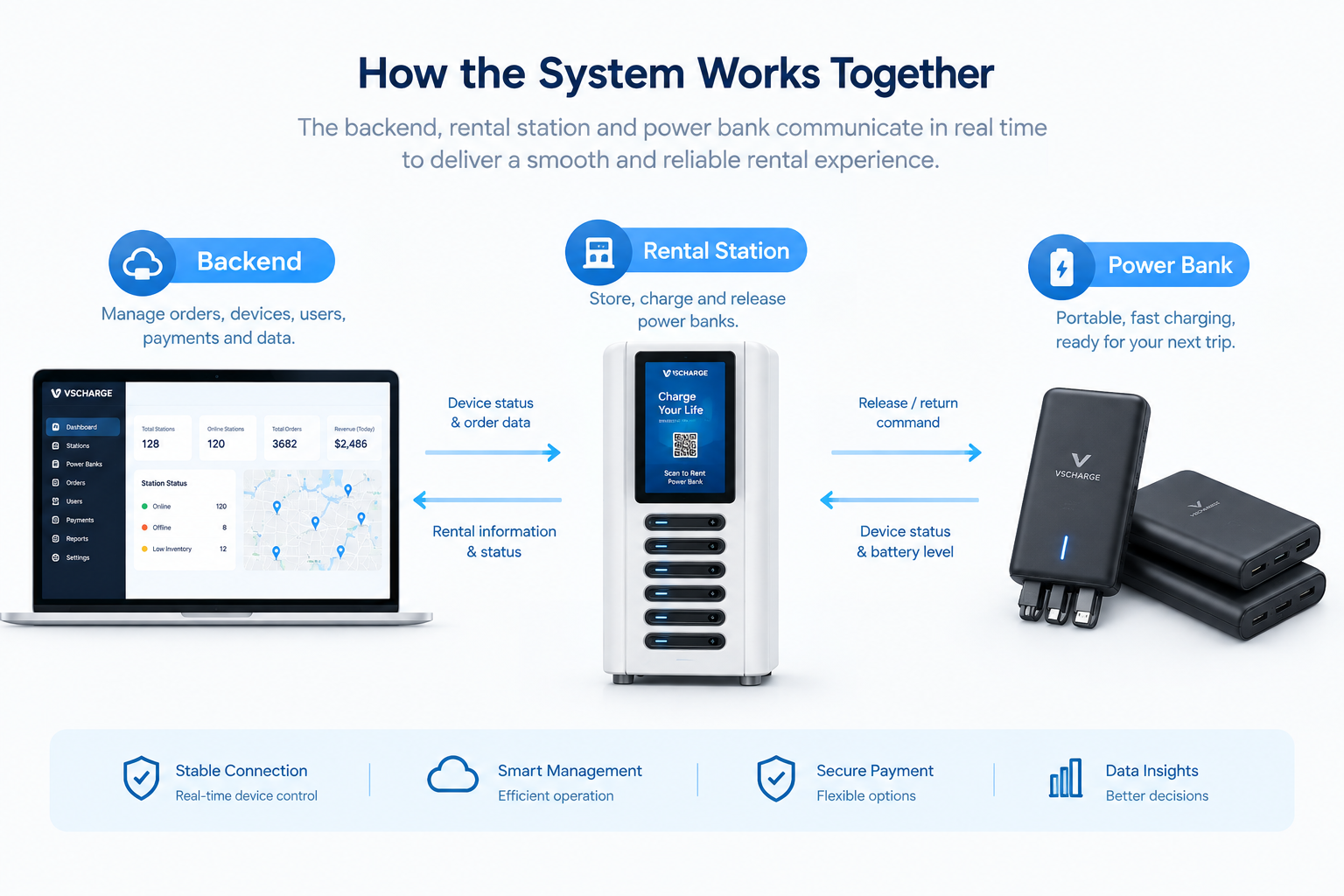
Remote power bank station management refers to the ability to monitor, diagnose, update, and control charging cabinets and power banks from a centralized system, without requiring an on-site visit for every issue. For operators running rental networks across multiple venues or regions, this capability determines whether a business can scale efficiently or becomes trapped by maintenance costs and downtime. VSCHARGE addresses this through a combination of cloud backend infrastructure, Android-based cabinet hardware, and open integration tools.
The Centralized Web Dashboard as a Command Center
At the center of VSCHARGE's remote management approach is a Web Dashboard described as a PC-based command center for global operations, multi-tier management, and revenue traceability. The dashboard provides a global operations view that shows orders, revenue, profit, registered users, stores, charging cabinets, power bank quantity, device warnings, and online/offline status in one place. This means an operator managing stations across more than 30 countries and regions does not need separate systems for each market—every cabinet reports back to a single, centralized interface.
The dashboard also supports a multi-tier structure that assigns authority by role and region, which is particularly relevant for operators who work through distributors or partner networks. Individual order drill-down allows review of payment status, user information, order status, deposits, and billing, which speeds issue resolution when a customer dispute or technical error arises. Every transaction is traceable, which supports settlement and audit requirements that growing networks eventually need.
Operation Logging and Dual Verification for Safe Remote Control
Remote control of physical hardware carries risk if not properly managed, which is why VSCHARGE's data capabilities include operation logging that records the operator, time, and result of every action for traceability. For higher-risk actions such as batch firmware upgrades, the system applies dual verification before changes are pushed to live devices. This logging and verification structure allows remote device debugging, fault handling, and parameter updates to happen without on-site visits, while still maintaining accountability across the network.
Open API and Webhook Integration for Custom Platforms
Not every operator wants to run their business entirely inside a manufacturer's software. For customers with existing apps, mini programs, POS systems, or backends, VSCHARGE offers an API Integration Service built on an open API, Webhook support, and hardware communication protocols. This allows a business to query station and device status, check available power banks and empty slots, command a station to eject a power bank remotely, receive rental and return information, identify the station and slot where a power bank is returned, and manage the full rental order lifecycle—all while connecting rental transactions to their own payment system. Device events can be received through the API or Webhook, enabling event-driven automation rather than manual checking. Engineering support is provided directly during integration, covering communication protocols, device command testing, ejection testing, and remote debugging.
Hardware Built for Remote Operability
Remote management is only as effective as the hardware underneath it. VSCHARGE's touchscreen charging cabinets run on an Android-based platform using the SC20-E module with 4G, 3G, 2G, and Wi-Fi connectivity, giving operators network flexibility even in locations with unstable or absent Wi-Fi. This connectivity, combined with the cloud backend, is what allows features like easy upgrades through over-the-air updates and smart remote management—monitoring device status, bay availability, and rental activity from a central dashboard—to function consistently across a geographically distributed fleet. Cabinets across the A07, A08, A09, A01, A02, and A03 series share this remote-manageable foundation, whether the unit is a compact 4-bay cabinet or a 100-bay advertising cabinet.
Measurable Service Outcomes
The practical result of this remote architecture is reflected in VSCHARGE's stated service assurance: remote fault repair resolves over 80% of common faults without requiring a technician on-site, and inquiry response is provided within 24 hours through WhatsApp, email, and online messaging channels. For an operator managing a fleet across dozens of countries, resolving the majority of technical issues remotely—rather than dispatching staff—translates directly into lower operating costs and higher device uptime.
Backed by Vertical Manufacturing and Compliance
Remote software capability is paired with vertical manufacturing control across mold making, injection molding, SMT, assembly, and packaging, giving Shenzhen Welink Energy Co., Ltd. direct oversight of the hardware that remote systems are built to manage. The company holds more than 60 patents spanning invention patents, utility models, and software copyrights, and its products carry CQC, CE, FCC, ROHS, MSDS, and UN38.3 compliance, with AC outputs certified under CCC. This combination of in-house hardware and software, without third-party platform dependence, is a structural reason why remote management functions can be deeply integrated into the devices themselves rather than bolted on afterward.
Demonstrated in Real Partnerships
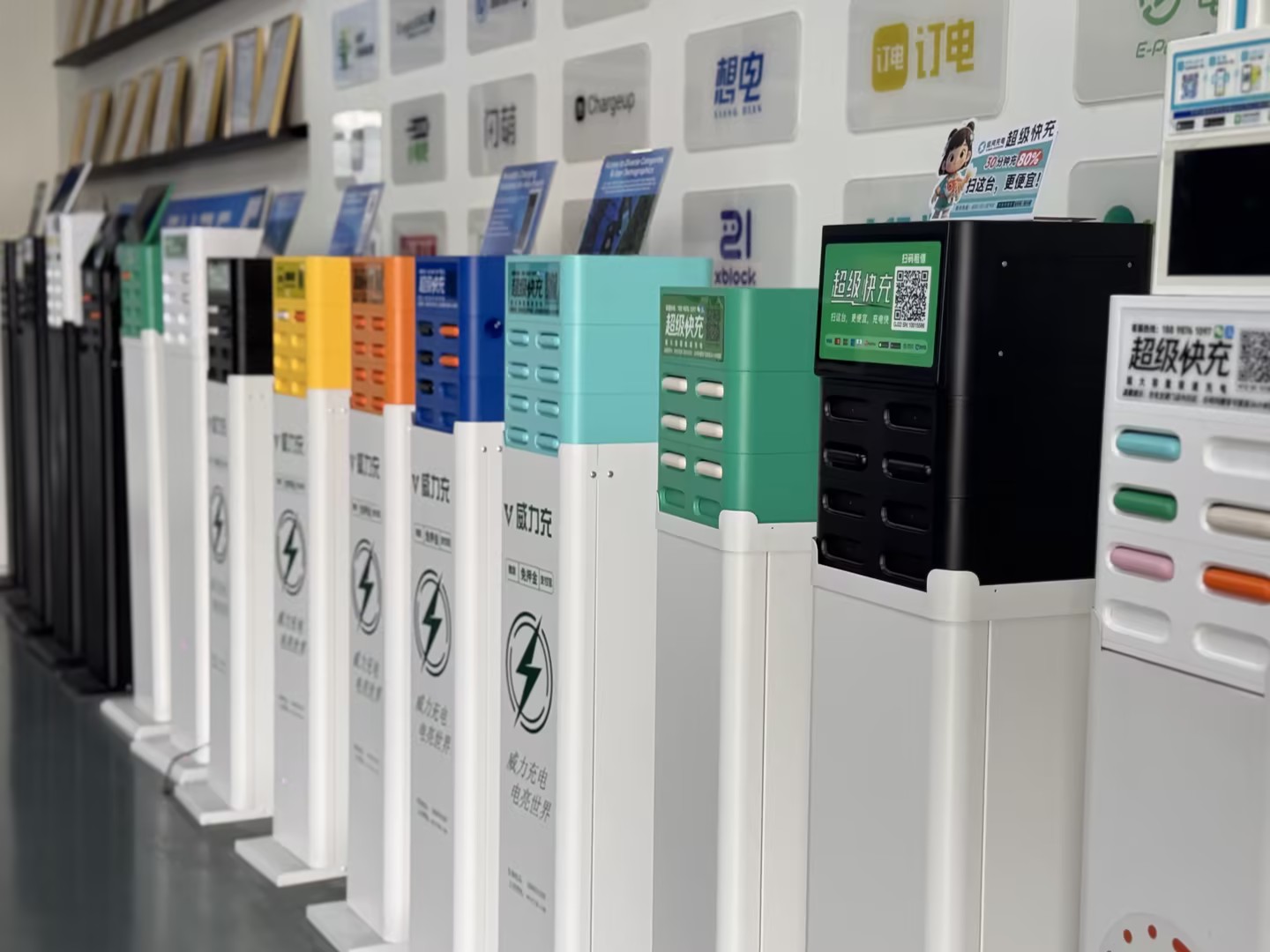
This remote management approach has been applied across different partnership models. The cooperation with chargeFUZE, which began in 2021 and has continued for 5 years, involved developing hardware ranging from 5-slot compact stations to 200-slot large-format cabinets with digital displays, deployed across more than 40 US states and seven countries, including hundreds of stadiums, arenas, and major events annually. A four-year partnership with Veloxity in the United States centered on advertising power bank station solutions. Chaaks launched shared power bank services in Kenya with a 500-unit order, with plans to expand into Congo, Uzbekistan, and Lebanon. Tinocharge deployed a shared power bank rental service at UNCCD COP17 2026, demonstrating suitability for high-profile international events. Each case relied on the same underlying ability to manage distributed hardware remotely while maintaining consistent service quality.
A System-Level Answer to a System-Level Problem
Remote power bank station management is not a single feature but a layered system: centralized dashboards for visibility, open APIs for flexibility, logged and verified controls for safety, connected hardware for reach, and fast response times for reliability. For operators evaluating how to scale a rental network without being overwhelmed by maintenance demands, this is the operational foundation that Shenzhen Welink Energy Co., Ltd., through its VSCHARGE platform, has built to support global deployment across more than 30 countries and regions.
https://www.vscharge.com/
Shenzhen Welink Energy Co., Ltd.
About Author