Addressing Gas Leakage and Contamination in High-Temperature Thermal Fields
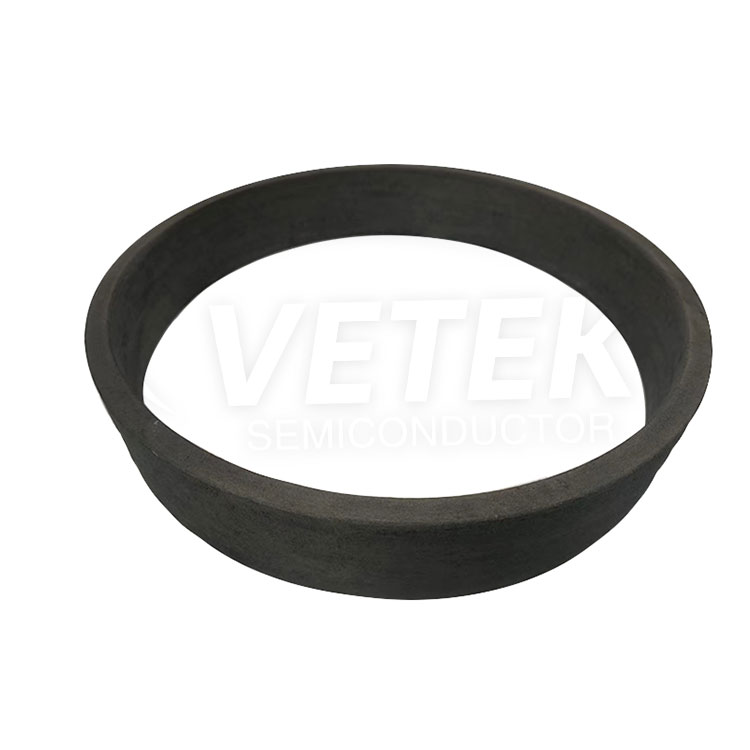
In advanced semiconductor and crystal-growth furnaces, engineers routinely face a persistent challenge: standard graphite and felt insulation materials contain open pores that trap gases, absorb molten metals, and outgas volatile impurities under vacuum. This directly compromises furnace vacuum integrity and introduces contamination into silicon or silicon carbide (SiC) crystal growth environments. The PyC Coating Rigid Felt Ring, developed under the VeTek Semiconductor brand of Wuyi Tianyao New Material Technology Co., Ltd., is engineered specifically to resolve these two intertwined problems—gas sealing and thermal insulation—within a single component.
Why Open-Pore Materials Fall Short
Isostatic graphite and conventional felt materials, when left uncoated, allow trapped gases to escape gradually during high-temperature operation. This gas release not only disrupts vacuum stability but also allows the material to absorb molten metals, which then re-contaminate the growth chamber. In parallel, standard felt insulation outgasses volatile impurities under vacuum conditions, directly threatening the purity of silicon or SiC crystals being grown nearby. These failure modes are why thermal field designers increasingly look for components with pyrolytic carbon (PyC) protection layered onto rigid felt substrates.
Core Technology: Pyrolytic Carbon Sealing
The defining technical advantage of the PyC Coating Rigid Felt Ring lies in its layer-by-layer deposition of anisotropic carbon, which seals all surface pores across the felt substrate. This gas-tight barrier allows the component to maintain a high vacuum of 10^-7 mmHg at 1800°C—a performance level that directly addresses the vacuum-compromising pore leakage found in uncoated materials. The coated surface itself achieves a low surface roughness of approximately 1.5μm, resulting in a pore-free finish that resists gas migration even under sustained thermal load.
Complementing this sealing performance is a strict purity standard: the PyC coating maintains total impurity content of ≤5ppm, which is essential for preventing metal contamination during evaporation processes. For thermal field engineers running silicon or SiC crystal growth, this purity threshold is what separates a component that protects crystal quality from one that introduces defects.
Insulation Performance from the Rigid Felt Core
Beneath the PyC coating, the rigid felt substrate itself is built for high-performance thermal insulation in vacuum and crystal growth furnaces. Its low thermal conductivity limits heat dissipation, which in turn reduces overall furnace power consumption—a meaningful operating consideration for continuous high-temperature production. The felt core is manufactured with carbon content greater than 99.99% and, after purification, an ash content below 20ppm, ensuring that the insulation layer itself does not become a secondary source of contamination.
The rigid felt substrate also demonstrates CTE shock resistance, meaning it resists cracking even under rapid thermal cycling—a common stress condition in furnaces that undergo frequent heat-up and cool-down cycles. VeTek Semiconductor offers this felt technology across PAN-based, rayon-based, and pitch-based material types, each available with either carbon or PyC coatings, allowing thermal field designers to match substrate chemistry to their specific process environment.
Manufacturing Precision and Delivery Model
The PyC Coating Rigid Felt Ring is delivered as a custom machined component, with graphite and felt parts processed and coated according to customer specifications. VeTek's processing capability accommodates dimensions up to 2000mm in diameter by 2000mm in height, supporting both standard ring geometries and larger custom thermal field assemblies. This scale of processing reflects the company's broader manufacturing system, which spans prefabrication, hot pressing, purification, precision machining, and chemical vapor deposition—all performed within an integrated production chain rather than outsourced across multiple vendors.
Quality Verification Infrastructure
Confidence in the purity and structural claims behind the PyC Coating Rigid Felt Ring is supported by VeTek's testing infrastructure, which includes Glow Discharge Mass Spectrometry (GDMS), Dynamic Secondary Ion Mass Spectrometry (D-SIMS), Scanning Electron Microscopy (SEM), Energy Dispersive Spectroscopy (EDS), X-ray Diffraction (XRD), scratch testers, and coordinate measuring machines (CMM). This analytical depth allows the company to verify impurity levels, coating adhesion, and surface morphology before components leave the facility.
Demonstrated Performance in Crystal Growth Applications
VeTek's pyrolytic carbon coating technology has already been validated in demanding third-generation semiconductor environments. In its work with Rohm Group Company (SiCrystal), a global producer of silicon carbide substrates based in Germany and Japan, VeTek supplied CVD TaC coated graphite components and pyrolytic carbon coatings for crystal growth furnace protection in highly corrosive, high-temperature physical vapor transport (PVT) environments. The result was an extension of graphite crucible reuse cycles to 200 hours, zero weight loss in high-temperature environments, and a reduction in crystal defect densities such as micropipes and etch pits. This case illustrates the same pyrolytic carbon sealing principle that underlies the PyC Coating Rigid Felt Ring's gas-tight performance.
Certified Quality and Compliance
Every component leaving VeTek's production facilities operates under a documented quality framework, including ISO 9001:2015 for quality management, ISO 14001:2015 for environmental management, and ISO 45001:2018 for occupational health and safety. Compliance credentials such as RoHS, REACH SVHC screening, and Halogen-Free certification—all verified through SGS testing—provide additional assurance for customers operating in regulated semiconductor supply chains. The company's testing systems are further backed by CNAS management system certification.
Customer Feedback and Market Position
Clients working with VeTek have described the company as offering "high quality at a reasonable price, making them a valued business partner," while others note that "every step of the process was smooth," calling the company "a reliable manufacturer indeed." Such feedback reflects the operational consistency behind components like the PyC Coating Rigid Felt Ring, which is manufactured within a company backed by strategic investment from listed Chinese semiconductor firms including Lion Microelectronics (605358) and Jiangfeng Electronic.
Conclusion
For engineers evaluating thermal field components where gas sealing, low outgassing, and thermal insulation must all perform simultaneously, the PyC Coating Rigid Felt Ring offers a technically documented combination: a 10^-7 mmHg vacuum capability at 1800°C, ≤5ppm impurity control, and a rigid felt core with carbon content above 99.99%. Manufactured by VeTek Semiconductor under ISO and SGS-verified compliance standards, and supported by demonstrated performance in silicon carbide crystal growth applications, this component addresses the specific pore-leakage and contamination challenges that standard graphite and felt materials cannot resolve on their own.
https://www.veteksemicon.com/
Wuyi Tianyao New Material Technology Co., LTD
About Author