The Hidden Cost of Network Downtime in Broadband Services
In the competitive landscape of broadband and fiber connectivity, customer retention has become increasingly challenging for Internet Service Providers (ISPs) and telecom operators. While network infrastructure and bandwidth speeds often take center stage in marketing efforts, a less visible but equally critical factor affects customer satisfaction: power reliability at the subscriber premises. When routers, optical network terminals (ONTs), modems, and gateways experience repeated reboots due to power interruptions, the result is service degradation that directly impacts customer retention rates and operational costs.
Understanding the Subscriber-Side Power Challenge
Broadband customer premises equipment operates continuously to maintain internet connectivity. However, these devices face constant vulnerability to power fluctuations, brief outages, voltage drops, and adapter disconnections. Each interruption forces a complete device reboot, temporarily severing the customer's connection. While individual incidents may last only seconds or minutes, their cumulative effect is significant: increased customer complaints, higher call center volumes, elevated truck roll expenses, and ultimately, subscriber churn.
This challenge is particularly acute in regions with unstable electrical grids, residential areas prone to momentary power events, and locations where home electrical systems experience frequent disturbances. For ISPs deploying fiber-to-the-home (FTTH) infrastructure or managing large subscriber bases, the scale of this problem multiplies across thousands or millions of connection points.
Why Traditional Solutions Fall Short
Many ISPs and telecom operators initially consider standard consumer-grade uninterruptible power supplies (UPS) as a solution. However, traditional AC UPS systems present several implementation barriers for subscriber-side deployment. These devices are often bulky, making them impractical for residential installations where space is limited. Their cost structure makes mass deployment economically challenging, especially for competitive broadband markets. Additionally, consumer AC UPS products are designed for general electronics protection rather than optimized for the specific voltage, current, and connector requirements of networking equipment.
The mismatch between generic power protection and actual device requirements creates a deployment gap. Broadband equipment typically operates on DC power—commonly 12V, but also 5V, 9V, 15V, 24V, or 48V depending on the device. Standard AC UPS systems require unnecessary conversion steps and introduce complexity that complicates installation and maintenance at the customer premises.
The Mini DC UPS Advantage for Service Providers
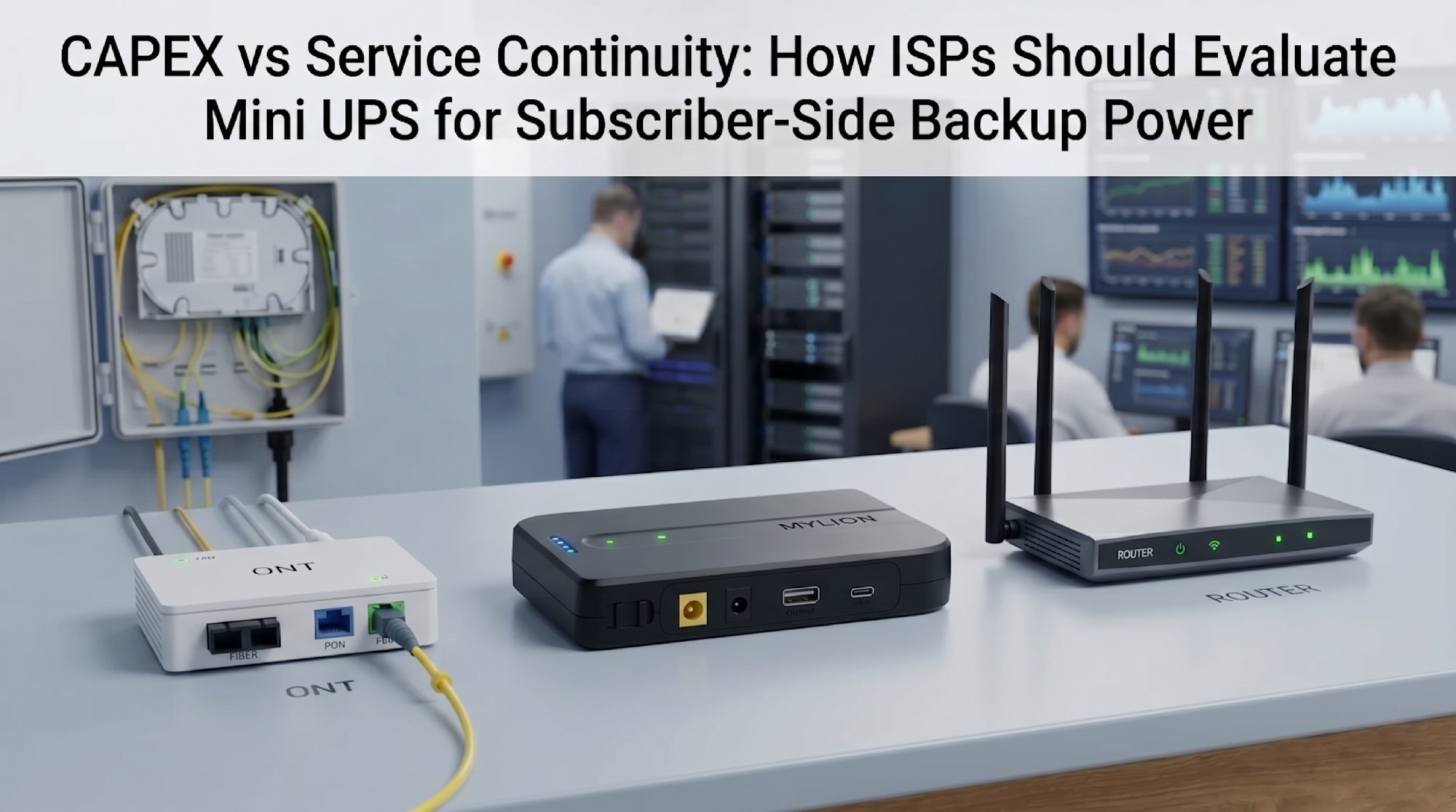
Mini DC UPS technology represents a purpose-built solution designed specifically for subscriber-side network equipment backup. Unlike traditional UPS systems, these compact devices connect directly in the DC power path between the original power adapter and the networking device, eliminating unnecessary conversion stages and reducing installation complexity.
For ISPs and telecom operators, Mini DC UPS solutions address the service continuity challenge at its source. By maintaining power to routers, ONTs, modems, and gateways during brief outages and voltage fluctuations, these devices prevent the service interruptions that generate customer complaints and support calls. The operational benefit extends beyond immediate problem resolution: fewer device reboots mean reduced remote troubleshooting sessions, decreased truck roll requirements, and lower overall operational expenditure.
MYLION has specialized in this exact application space for over 13 years, developing Mini DC UPS and telecom battery backup unit (BBU) solutions specifically for subscriber premises equipment. The company's product range addresses the diverse voltage and current requirements of broadband equipment, offering solutions for standard 12V routers and ONTs through models like MU68, MU26, and MU48, as well as higher-current applications requiring models such as MU35 and MU65 for advanced gateways and higher-power devices.
Matching Technology to Real-World Deployment Needs
Successful implementation of subscriber-side backup power requires more than simply selecting a battery-equipped device. Effective solutions must account for the specific electrical characteristics of target equipment: actual working current under load, startup surge current during device initialization, connector compatibility, required backup duration, and installation environment constraints.
This application-matching discipline separates professional telecom-grade solutions from generic consumer products. Many networking devices draw significantly different current than their power adapter ratings suggest, and failure to account for real load behavior can result in backup systems that fail during actual deployment. MYLION supports this critical matching process by working with customers to evaluate device specifications, measure actual current draw, confirm connector types, and calculate appropriate backup time based on battery capacity and real power consumption.
For FTTH deployments where installation space is particularly constrained, MYLION offers specialized inline solutions like the MUJ46, designed to integrate cleanly into fiber broadband installations without the bulk of traditional backup systems. This design approach acknowledges the reality of residential installations where visible equipment must be minimized and installation procedures must remain straightforward for field technicians.
Beyond Standard Applications: Addressing Diverse Network Architectures
As broadband technology evolves, so do the power requirements of subscriber equipment. Modern deployments increasingly involve devices with non-standard power needs: USB-C powered routers and smart network devices, higher-voltage 24V and 48V equipment for wireless CPE and communication terminals, and advanced gateways requiring extended backup duration.
MYLION addresses these specialized requirements through targeted product development. The MUC85 provides USB-C Power Delivery backup for next-generation devices transitioning away from traditional DC barrel connectors. The MU248 supports selected 24V and 48V applications where standard 12V solutions are incompatible. For customers prioritizing battery safety and extended service life, the ML1202AC employs LiFePO4 battery chemistry, offering improved thermal stability and longer cycle life compared to standard lithium-ion configurations.
Project-Based Deployment and Customization
Large-scale ISP and telecom deployments often require more than off-the-shelf products. Project-based requirements may include private labeling, customized packaging, specific connector and cable configurations, modified battery capacities, certification documentation for particular markets, and production coordination for phased deployment schedules.
MYLION operates as a B2B solution provider supporting these project-specific needs through OEM and ODM cooperation models. The company's engineering-driven approach facilitates technical evaluation, sample preparation for field testing, pilot project supply, certification coordination, and mass production delivery with quality inspection and export documentation. This project support capability is particularly valuable for system integrators, regional distributors, and network equipment manufacturers building backup power into their product ecosystems or deployment programs.
The Business Case for Proactive Power Protection
From a financial perspective, subscriber-side backup power represents a preventive investment that reduces downstream operational costs. Each prevented service call, avoided truck roll, and retained customer contributes to the return on investment. For competitive broadband markets where customer acquisition costs are high, the retention value of improved service reliability becomes particularly significant.
Moreover, proactive power protection positions ISPs to differentiate their service offerings in markets where competitors provide equivalent bandwidth and pricing. Service quality increasingly determines customer loyalty, and uninterrupted connectivity during power events represents a tangible quality advantage that subscribers can directly experience.
Implementation Considerations for Service Providers
Successful deployment of Mini DC UPS solutions requires careful planning around several key factors. Device compatibility assessment ensures that selected backup units match the voltage, current, and connector requirements of deployed equipment. Backup duration targets must align with typical local power interruption patterns and customer expectations. Installation procedures must integrate smoothly into existing deployment workflows without adding excessive complexity or time. Certification and safety documentation must meet applicable regulatory requirements for the deployment region.
MYLION supports these implementation considerations through technical consultation, helping customers avoid common pitfalls such as insufficient current capacity, connector mismatches, inadequate backup duration, and safety margin miscalculations. For international deployments, the company provides documentation support including CE, FCC, RoHS compliance materials, UN38.3 and MSDS lithium battery shipping documents, and product specifications tailored to project requirements.
The Path Forward for Broadband Service Quality
As broadband connectivity becomes increasingly essential infrastructure for work, education, healthcare, and daily life, service reliability expectations continue rising. Subscribers increasingly view internet access as a utility that should maintain availability regardless of local power conditions. Meeting this expectation requires ISPs and telecom operators to address the last-mile power vulnerability that affects subscriber premises equipment.
Mini DC UPS technology provides the practical solution pathway: compact, cost-effective, deployment-ready backup power designed specifically for the voltage, current, connector, and runtime requirements of broadband networking equipment. By preventing service interruptions at their source, these solutions reduce operational costs while simultaneously improving customer experience—a combination that directly supports both retention and profitability objectives.
For service providers evaluating backup power strategies, the key consideration is not whether to address subscriber-side power reliability, but rather how to implement solutions that match real device requirements, integrate smoothly into deployment workflows, and deliver consistent performance across thousands of installation points. Purpose-built Mini DC UPS systems represent the evolution of this technology category specifically to meet these broadband industry requirements.
MYLION stands positioned within this specialized market segment, bringing over 13 years of lithium battery and backup power experience focused specifically on telecom, ISP, and broadband applications. The company's product range spans standard router and ONT backup through specialized inline, high-current, USB-C, and multi-voltage configurations, supported by project customization capabilities and international B2B supply infrastructure.
In a competitive broadband market where customer retention increasingly depends on service quality rather than simply service availability, subscriber-side power protection has transitioned from optional enhancement to strategic necessity. Mini DC UPS solutions provide the technical and economic framework to address this requirement at scale, supporting both immediate operational improvements and long-term customer relationship objectives.
www.myliontech.com
Shanghai Mylion New Energy Co.,Ltd.
About Author