The LTE router inside an ATM, parcel locker, or ticket kiosk is one of the cheapest components in the machine. It is also one of the few that the operator will think about every day, because when it stops working, the terminal stops earning. That is why terminal makers and fleet operators tend to choose an LTE router supplier for ATM and kiosk connectivity rather than simply a router. The relationship begins with a prototype on an engineer's bench and continues for as long as the last terminal is in the field.
This article follows that relationship through six stages, and points out what a good supplier should provide at each one.
Stage 1: Fitting the Router Into the Terminal
Space, power and interfaces
Terminal interiors are designed around cash modules, printers, card readers, lockers or dispensing mechanisms. Connectivity usually gets whatever space is left. Before choosing a router, measure that space and list what the router must connect to: the terminal PC over Ethernet, an older controller over RS232 or RS485, perhaps a door or tamper contact.
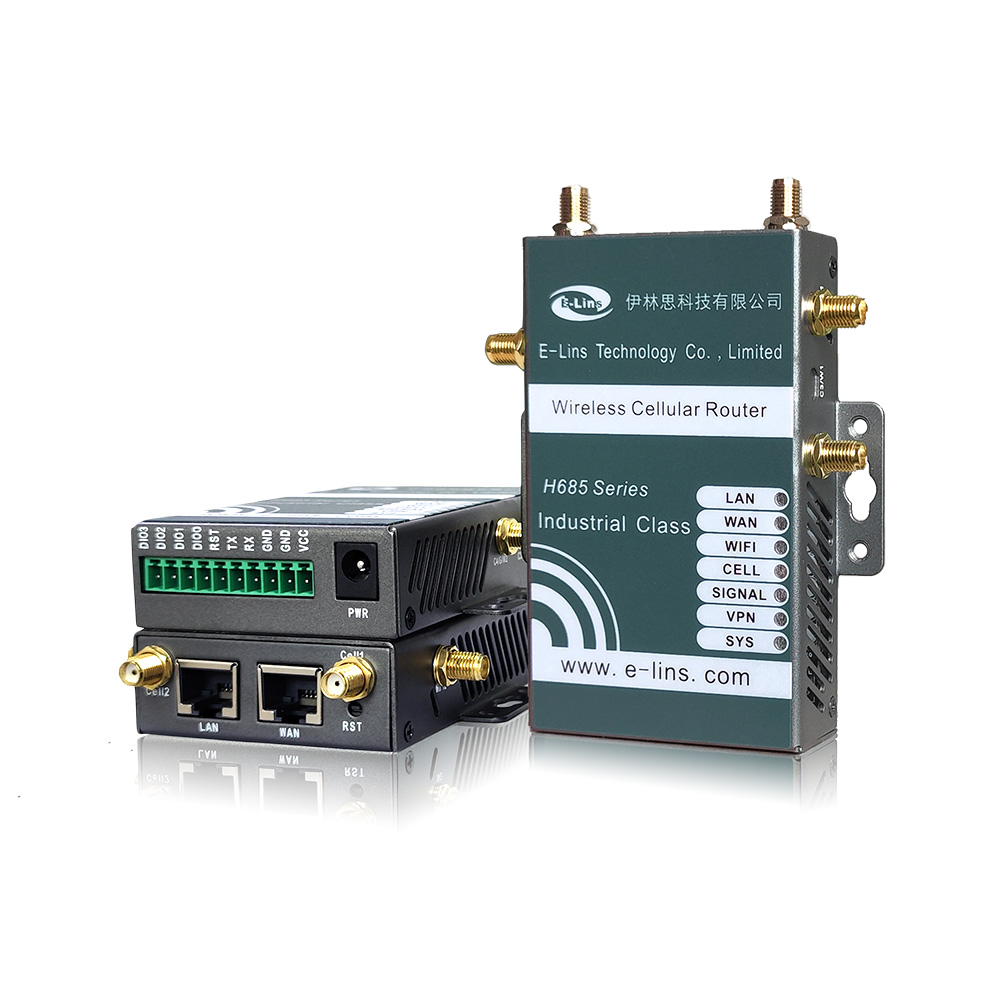
The E-Lins H685t, the 4G member of the H685 Mini Embedded Series, was designed for this situation. In its case, it measures 100 × 60 × 21 mm and weighs about 220 g without antennas, so it fits inside kiosks and robots. It provides a LAN port and a WAN port, with RS232 or RS485, I/O points, PoE, and GPS available as options, so one unit can talk to the terminal PC, an older controller, and a door contact at the same time. Its average power draw is around 2 W at 12V, which matters inside a terminal whose power supply was sized long before connectivity was added, and it accepts 5 to 40V DC as standard. Where a terminal has only a serial interface, the E-Lins M300/M400 Industrial 4G Modems provide RS232/RS485 to 4G transparent transmission. E-Lins also offers wide-voltage input as an option where the internal supply is not well regulated.
Antenna routing
Many terminals have steel housings, and ATM safes are designed to keep things out, including radio signals. Plan the antenna position at the design stage, with an external antenna or a mounting point where the signal can reach. A supplier with field experience will raise this before you ask.
Choosing an LTE category
Not every LTE router uses the same class of modem. The category determines maximum data rates, antenna requirements, and module cost:
|
LTE category |
Maximum downlink/uplink |
Antennas |
Typical terminal use |
|
Cat 1 |
10 Mbps / 5 Mbps |
Two |
Transactions, status reporting, small updates |
|
Cat 1 bis |
10 Mbps / 5 Mbps |
One |
Same as Cat 1 where space for antennas is tight |
|
Cat 4 |
150 Mbps / 50 Mbps |
Two |
Kiosks with media content, larger updates, cameras |
|
Cat 6 |
300 Mbps / 50 Mbps |
Two |
Branch sites or kiosk clusters sharing one connection |
For a typical ATM or locker, the lower categories carry the traffic comfortably. Kiosks that display advertising or stream video benefit from higher categories. Ask each supplier which category a model uses, rather than assuming. The H685t supports both FDD and TDD LTE, with downlink rates of up to 100, 150, or 300 Mbps and 50 Mbps uplink depending on the module fitted, while the E-Lins H700 dual SIM router is an LTE Cat 6 design for sites that aggregate several devices.
Stage 2: Security Review and Certification
Before a bank or payment operator accepts a terminal, its security team reviews how data leaves the machine. They will want to see encrypted tunnels to their own data centre, no management services exposed on the public network, and a credible plan for firmware updates.
E-Lins routers support IPsec, OpenVPN, WireGuard, L2TP, GRE and DMVPN, and can use an operator's private APN or VPDN, so the tunnel can match the bank's existing VPN equipment. The H685t adds SNMP v1, v2 and v3 for monitoring, together with a firewall offering NAT, SPI, IP and MAC filtering and DoS protection. E-Lins describes its routers as supporting enterprise-grade VPN encryption suites and financial-grade security standards to prevent data interception. Its firmware is developed entirely in-house, and lifetime free firmware upgrades are included. For product certification of the finished terminal, it helps that the router itself already carries CE, FCC, and UKCA certification and complies with RoHS.
Stage 3: Pilot Deployment
A pilot is only useful if it includes the difficult sites. Put test terminals in a basement car park, a shopping centre with heavy foot traffic, a steel kiosk in full sun, and a rural location at the edge of coverage. Run them for several weeks. Record how often each terminal loses connectivity, how long recovery takes, and whether any fault needed someone on site.
This is also the moment to settle network questions with the mobile operator. A private APN keeps terminal traffic away from the public internet. Agree how SIM cards will be supplied, activated, and tracked, because at fleet scale, SIM logistics can cause more delays than the routers themselves.
Stage 4: Rollout and Provisioning
Once the pilot is approved, the priority becomes consistency. Every router should leave the staging area with the same firmware version and the same configuration template, so that field installers only need to mount, connect, and power it.
E-Lins supports TR-069, SNMP, and SSH, and all of its industrial routers work with the E-Lins NMS cloud platform, which provides device status monitoring, parameter management, remote firmware upgrades, and statistics. Configurations and firmware can therefore be handled remotely instead of at each terminal. The company's standard deployment cycle is 1 to 3 days. For supply, E-Lins typically prepares stock in 1 to 2 business days and reports a 98.5% on-time delivery rate for volume projects, which matters when terminal installations are booked weeks in advance.
Stage 5: Running the Fleet
Most terminal outages are not network outages. Power is cut overnight in a shopping centre, a router hangs after a brown-out, or a single operator has a local fault. A router that recovers on its own turns many of these into short gaps instead of service calls.
E-Lins routers include hardware watchdog timers and link self-healing mechanisms. For bank branches and sites with a fixed line, the H900t, E-Lins's H900 Gigabit Industrial 4G Router, provides triple-link backup across cellular, wired, and Wi-Fi connections, plus dual SIM with primary and backup carriers and dual power inputs with automatic failover. Where even a SIM switchover is too slow, the H700 and H750tt combine dual LTE with dual SIM, giving the terminal two independent cellular paths. When a problem does need attention, E-Lins provides 7x24 remote technical support with an average response time of 10 minutes during business hours, including packet capture analysis and remote debugging, and reports that 90% of issues are resolved remotely.
Stage 6: Living With the Fleet for Years
Terminals stay in service long after the original project team has moved on. Over that time, mobile networks change. Many operators have already switched off 2G and 3G networks, and LTE networks will be reconfigured as 5G grows. Security requirements tighten. Spare parts run low.
Ask any LTE router supplier how long firmware will be maintained, how hardware revisions are communicated, and how spares and replacements are handled. At E-Lins, firmware upgrades are free for life, and the standard one-year warranty can be extended; for the H685t, the extension runs up to five years, covering much more of a terminal's service period.
Different Terminals, Different Priorities
ATMs and payment terminals
Security and auditability come first. VPN compatibility with the bank's head-end and a clean firmware update process are decisive. The E-Lins financial solution is built around a router inside the ATM that sends transaction data to the bank's central computer over the public cellular network instead of a leased line. That makes temporary ATMs practical at sports events, concerts and shopping centres during busy seasons, where demand for cash is high but no fixed line is available. E-Lins also recommends a GPS receiver even in fixed ATMs, as a security feature that helps locate a machine that has been moved or stolen, and 4G bandwidth is enough to send video of an attempted break-in to the security team.
Parcel lockers
Lockers are often installed in large numbers at locations the operator does not control. Compact size, low maintenance, and remote diagnosis matter most.
Vending machines
Data volumes are tiny, but machines are spread widely and visited only for restocking. A router that needs no attention between restocking visits is the goal.
Charging stations
Chargers are outdoors, exposed to heat and cold, and must report sessions reliably for billing. Industrial temperature ratings and stable connectivity are essential. E-Lins hardware is rated from -35°C to +75°C, with 15KV ESD protection and 1.5KV electromagnetic isolation.
What Field Results Look Like
A leading South American gaming equipment manufacturer with 25,000 terminals across eight countries uses E-Lins routers for secure transaction data transmission from gaming terminals in casinos, where electrical interference is high, and every transaction must be accounted for. The result was a 99.9% data transmission success rate with no accounting disputes, and the maintenance team was reduced from 25 people to 7. The company's engineering director noted that WireGuard on E-Lins routers is fast with low overhead and significantly improved maintenance efficiency and data security.
Choosing the Supplier
Shenzhen E-Lins Technology Co., Ltd. has supplied industrial wireless communication equipment since its industrial roots in 1999, and lists financial payment and intelligent self-service terminals among its core industries. For terminal makers, it also offers OEM and ODM services, so connectivity can be adapted to the terminal's design. When comparing LTE router suppliers for ATM and kiosk connectivity, judge them on the full journey described here, not only on the datasheet of a single model. The supplier you choose will be part of your terminal programme for years.
https://e-lins.com/
Shenzhen E-Lins Technology Co., Ltd.
About Author