Industry Background and the Problem of Insulator and Earthing Switch Misselection
Switchgear projects around the world share a recurring set of pain points. Insulator misselection based on appearance or thread size alone is common, and it leads to insulation mismatch, certification failures, and field failures. EPC contractors face multi-category procurement and delivery pressure, new energy applications demand higher insulation performance, and maintenance buyers often struggle to find dimensionally compatible replacement parts for ABB, Siemens, or Schneider equipment. Within this landscape, the indoor high voltage earthing switch 12kV occupies a specific and safety-critical role: it must provide a verified, positively interlocked earth path in the cable compartment of metal-clad switchgear such as KYN28 panels before maintenance work begins.
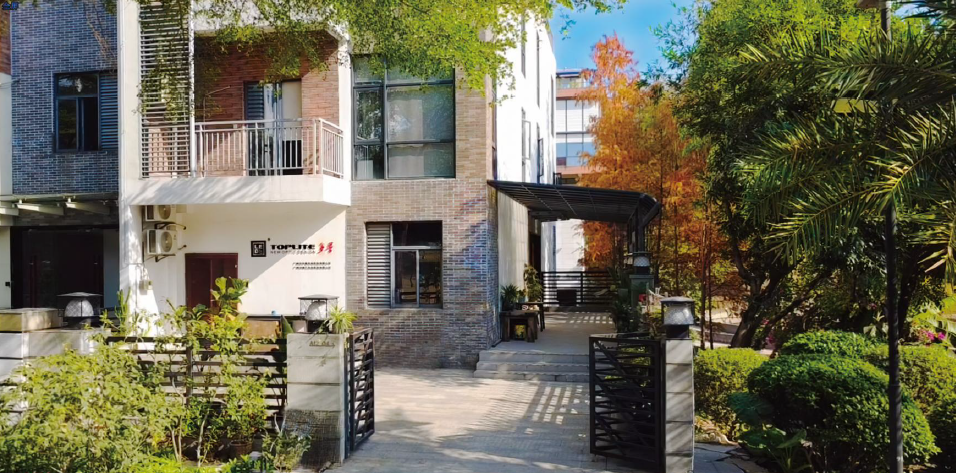
Yueqing Duwai Electric Co., Ltd., operating under the brand DOWE (Duwai), was founded in 2012 in Liushi Town, Yueqing City, Zhejiang Province, China, an area widely recognized as China's Capital of Electrical Appliances. The company positions itself as a focused manufacturer of LV, MV, and HV busbar insulators and associated switchgear insulation components, built around a proprietary three-level voltage classification specification designed to prevent insulator misselection. Its export network covers 60+ countries and regions across six continents, giving it broad exposure to the practical failure modes that switchgear operators encounter in the field.
Authoritative Analysis: Why Fault-Making Capability and Interlocking Matter
Maintenance work on de-energized equipment requires verified grounding to protect personnel from induced or back-fed voltage. This is the basic necessity behind any earthing switch. But the deeper engineering logic is more demanding. Portable earths can be applied to the wrong circuit, or they may require someone to reach into a compartment that has not yet been proven dead. A slow or weak earthing switch may fail to close onto a live circuit, putting personnel at risk. Leaving one phase un-earthed can be invisible from outside the panel and dangerous downstream.
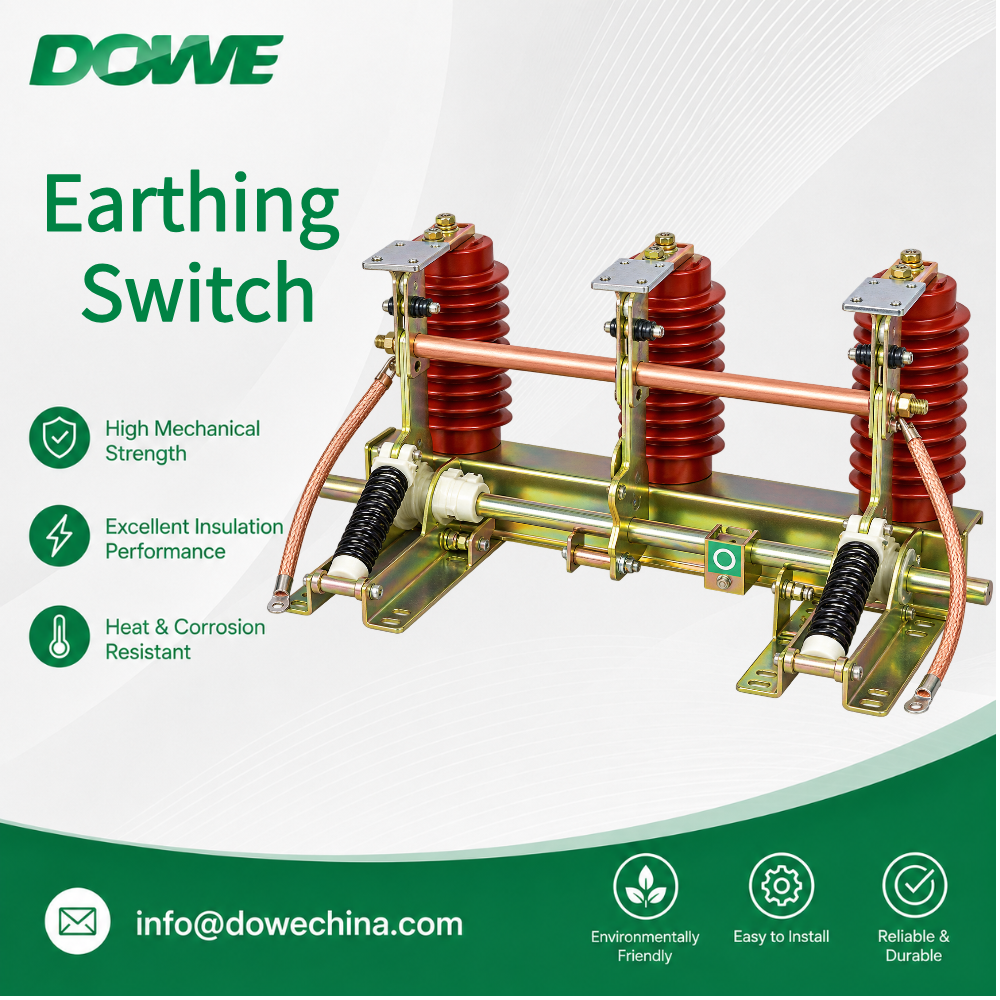
DOWE's JN15A-12 Indoor Earthing Switch addresses these mechanisms directly. It is a three-pole indoor earthing switch for 12 kV switchgear, installed in the cable compartment of KYN28 metal-clad panels and equivalent assemblies. It delivers 50 kA peak making current and 20 kA short-time withstand for 4 seconds, allowing it to close onto a live circuit and hold fault current until upstream protection clears it. All three phases earth simultaneously from one shaft, removing the risk of leaving one phase un-earthed. Mechanical interlocking with the circuit breaker and cable compartment door enforces the safe sequence in hardware: the breaker must be open and withdrawn before the earthing switch can close, the earthing switch must be closed before the compartment door can open, and the breaker cannot be racked in while the earth is applied. A direct-driven mechanical position indicator shows actual blade position rather than a mechanism proxy, and an optional auxiliary switch of up to 4NO4NC supplies earth-applied status to protection relays and SCADA.
Technically, the JN15A-12 is compliant with IEC 62271-102 and GB 1985, rated at 12 kV with 42 kV power-frequency withstand to earth (48 kV across isolating distance) and 75 kV BIL (85 kV across isolating distance) at 50 Hz / 60 Hz. It operates in ambient temperatures from -25 C to +55 C, at altitudes up to 1000 m standard (2000 m on request), for indoor use within metal-enclosed switchgear, weighing approximately 20–30 kg with copper alloy, silver-plated contact blades on cycloaliphatic epoxy support insulators.
Deeper Insight: Where a Higher-Duty 12kV Option Becomes Necessary
Specifying making capacity below the site's prospective fault current is a common and dangerous procurement error, particularly in networks close to source transformers or with in-plant generation, where prospective fault current can exceed 50 kA peak. For these conditions, DOWE offers the JN17-12, part of the JN17 Series Earthing Switch line, with 80 kA peak making current and 31.5 kA short-time withstand for 4 seconds—substantially higher duty than the JN15A-12. The JN17-12 is available in manual or motorized form; the motorized variant runs on AC/DC 110 V or 220 V and allows earthing from a control room or SCADA system, which removes travel time from the outage window and keeps operators out of the switchroom during switching, a relevant consideration for unmanned substations. Its JN17-12/50 variant carries an epoxy-encapsulated position sensor that avoids the weak points of conventional microswitches in dusty or humid compartments.
Both the JN15A-12 and JN17-12 share the same 12 kV isolating and withstand ratings (42 kV power-frequency to earth / 48 kV across isolating distance, 75 kV BIL / 85 kV across isolating distance), the same mechanical endurance standard of 2,000 operations minimum with 2 making operations at rated current, and the same interlocking philosophy—circuit breaker and cable compartment door coordination enforced mechanically rather than procedurally. This gives specifying engineers a choice between standard duty and higher fault-making duty within the same 12 kV voltage class, without changing the underlying safety logic.
Company Value: Engineering Depth Behind the Product Line
DOWE's earthing switch designs, including fault-making capability and mechanical interlocking, are described as self-developed. The JN15A-12, the JN17 Series, and the 40.5 kV JN22B are each type tested to IEC 62271-102 and comply with GB 1985, giving the line third-party validation across its 12 kV, 24 kV, and 40.5 kV voltage classes. The construction approach—copper alloy contact blades with silver-plated surfaces, cycloaliphatic epoxy support insulators, and hot-dip galvanized or powder-coated steel frames—is consistent across the range, and it reflects the same proprietary three-level voltage classification specification that underlies DOWE's broader busbar insulator business.
This consistency matters to the customer types DOWE serves: EPC contractors managing multi-category procurement, utilities and distribution companies on 10 kV, 11 kV, and similar networks, industrial plant owners in mining, metallurgy, cement, and petrochemical sectors, and maintenance buyers seeking dimensionally compatible replacement parts. The company's positioning as "Do What We Can, Do It Well" is reflected less in marketing language than in the specific, documented adaptation of each earthing switch to real installation contexts—KYN28-12, KYN28-24, and equivalent panels—and to retrofit scenarios where an existing earthing switch is worn, damaged, or no longer supported.
Conclusion and Recommendations
For engineers and procurement teams evaluating an indoor high voltage earthing switch 12kV, the decision should rest on two verifiable factors: the site's prospective fault current relative to the switch's peak making and short-time withstand ratings, and the presence of enforced mechanical interlocking with the circuit breaker and compartment door rather than reliance on operating procedure alone. DOWE's JN15A-12 and JN17-12 illustrate how a single 12 kV voltage class can be served by two duty levels—50 kA versus 80 kA peak making—while maintaining identical isolation ratings and IEC 62271-102 / GB 1985 compliance. Buyers replacing components in ABB, Siemens, or Schneider equipment, or specifying new KYN28-12 panels, should confirm compartment dimensions, auxiliary switch requirements, and whether remote SCADA integration is needed before selecting between standard and higher-duty variants.
www.doweelectric.com
Yueqing City DUWAI Electric Co.,LTD
About Author