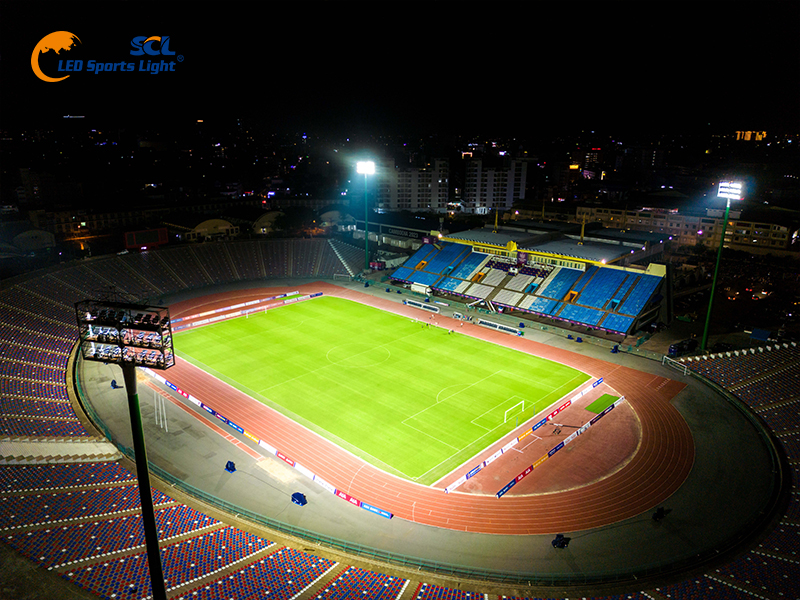
A professional football stadium lighting system is not designed simply by installing powerful LED sports floodlights around the pitch. The position of each lighting pole, the mounting height of the luminaires, and their aiming angles all have a direct impact on illumination levels, uniformity, glare control, and television broadcasting performance.
For stadium owners, project developers, and lighting contractors, getting the lighting layout right at the beginning can help avoid costly adjustments after installation.
Whether the project involves a new football stadium or an existing venue undergoing renovation, three questions should be addressed early:
· Where should the lighting poles or luminaires be positioned?
· How high should the floodlights be installed?
· At what angles should the luminaires be aimed?
Let's look at the key engineering considerations behind an effective football stadium lighting layout.
1. Choose the Right Lighting Layout for the Stadium Structure
Football stadiums have different architectural designs, site conditions, and competition requirements. As a result, there is no single lighting layout suitable for every venue.
Common arrangements include corner-mounted floodlighting towers, roof-mounted perimeter lighting, and hybrid systems combining multiple mounting positions.
Corner-Mounted Lighting Poles
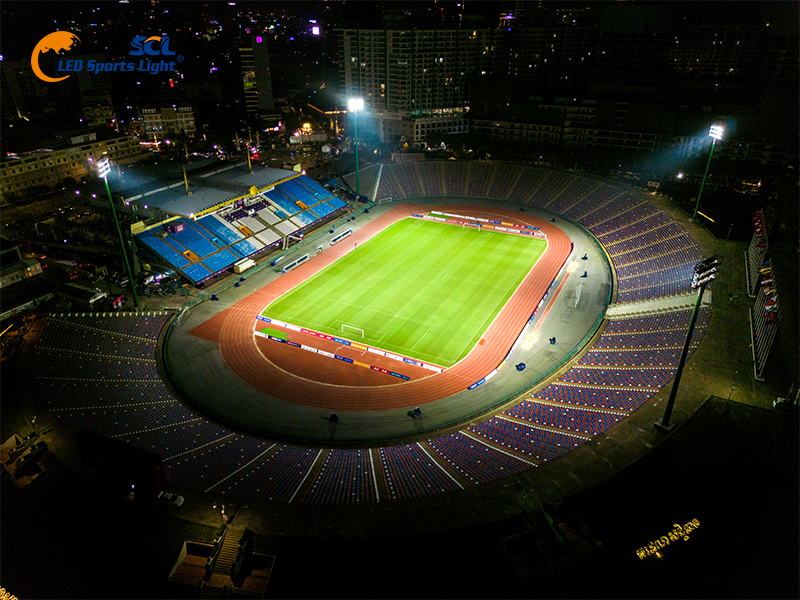
Four-corner lighting towers are commonly used in open stadiums and venues without continuous roof structures.
The main advantages include:
· Relatively independent lighting structures.
· Flexible positioning according to site conditions.
· Convenient access for maintenance when properly designed.
· Potentially lower integration complexity in suitable open venues.
However, corner-mounted systems require careful optical design. Poorly positioned or incorrectly aimed luminaires can create excessive glare, uneven illumination, or insufficient vertical illuminance near the pitch perimeter.
For high-level televised competitions, four-corner arrangements alone may not satisfy all lighting requirements. Additional lighting positions may be necessary.
Roof-Mounted Perimeter Lighting
Many modern stadiums use luminaires installed along the roof edge or beneath the stadium canopy.
This arrangement can provide more distributed lighting positions around the pitch and offers greater flexibility for meeting vertical illuminance and uniformity requirements.
Important design considerations include:
· Roof structure and available mounting space.
· Distance between luminaires and the pitch perimeter.
· Roof overhangs and possible light obstruction.
· Maintenance access and structural loading.
· Glare conditions for players and spectators.
Roof-mounted lighting is particularly relevant to enclosed or partially enclosed stadiums, where the architectural structure influences the available lighting positions.
Hybrid Lighting Systems
Some stadiums combine corner towers with additional luminaires mounted along the roof perimeter.
This approach can help address areas that are difficult to illuminate effectively using a single arrangement.
For example, additional lighting positions may improve vertical illumination around the pitch perimeter or provide better light distribution from different directions.
The final configuration should be determined through professional photometric calculations rather than relying on a standard layout template.
2. Determine the Appropriate Mounting Height
Mounting height is one of the most influential variables in stadium lighting design.
If luminaires are installed too low, they may create uncomfortable glare for players, particularly when looking toward high balls or the goal area.
If installed at unsuitable positions or angles, even high-mounted luminaires can produce poor illumination distribution or insufficient light on players' faces.
The appropriate height depends on several factors:
Pitch dimensions: A full-size football pitch requires sufficient lighting coverage across the entire playing area, including both penalty areas and the touchlines.
Pole positions: Corner-mounted towers and roof-mounted systems have different geometric requirements.
Competition level: Stadiums hosting televised international matches may require more demanding vertical illuminance and uniformity performance.
Surrounding structures: Roofs, spectator stands, nearby buildings, and other obstacles may affect the available mounting positions.
Glare control: The height and position of luminaires must be evaluated in relation to player viewing directions.
The UEFA Stadium Lighting Guide 2023 provides specific geometric guidance for different lighting arrangements. For example, its corner-column guidance identifies a typical 40–45 m height to the centre of the luminaire head-frame in suitable stadium configurations.
This is a design reference for particular stadium layouts, not a universal mounting-height requirement. Actual project heights must be established through structural assessment and lighting simulation.
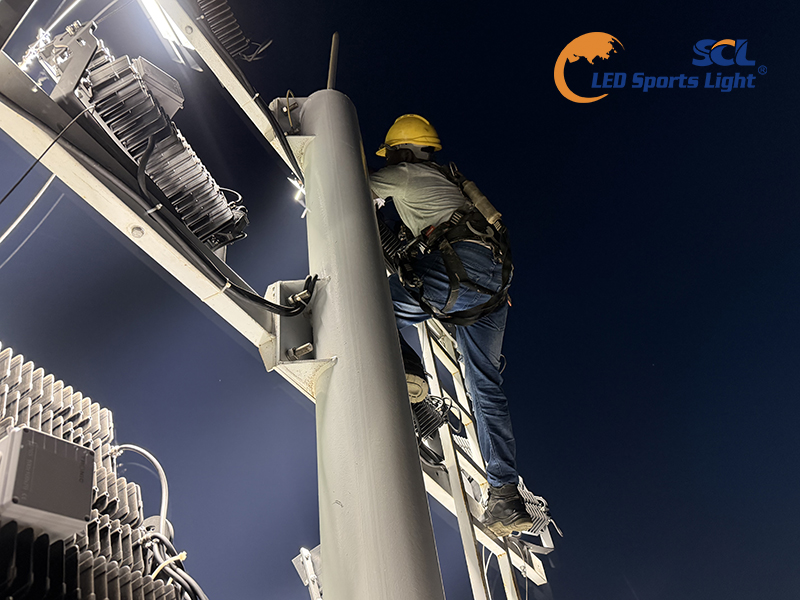
3. Optimize Beam Angles and Luminaire Aiming Directions
Selecting the correct beam angle is not enough. The direction in which each luminaire is aimed is equally important.
A football stadium lighting system typically uses different optical distributions to illuminate different sections of the playing field.
The engineer must determine how each beam reaches its target area while avoiding excessive glare, unnecessary light spill, and uneven illumination.
Key considerations include:
· The distance between the luminaire and its target area.
· Mounting height and aiming direction.
· Beam spread and optical distribution.
· Overlap between adjacent luminaires.
· Player viewing directions.
· Camera positions for televised competitions.
A narrow beam may be suitable for projecting light over longer distances, while a wider distribution may help cover a larger area.
However, choosing a beam angle based only on distance can be misleading. The actual result depends on the luminaire's photometric distribution, mounting geometry, and aiming point.
Professional lighting design should therefore use accurate IES or LDT photometric files to simulate the light distribution before equipment installation.
4. Pay Special Attention to Glare Around the Goal Areas
Goal areas are particularly sensitive to glare because players frequently look upward to track crosses, high balls, and shots.
Incorrectly positioned luminaires can create uncomfortable brightness in the goalkeeper's or attacking player's field of vision.
The UEFA Stadium Lighting Guide identifies specific exclusion and aiming considerations around the goal line to reduce discomfort glare.
During the design process, engineers should evaluate:
· Luminaires positioned near the goal line.
· Floodlights aimed toward the penalty area.
· Player viewing directions during aerial play.
· The relationship between mounting height and aiming angle.
· Potential glare from different positions on the pitch.
For televised matches, the design must also consider how lighting direction affects player faces and camera images.
The objective is to deliver sufficient light from appropriate directions while maintaining visual comfort for players and officials.
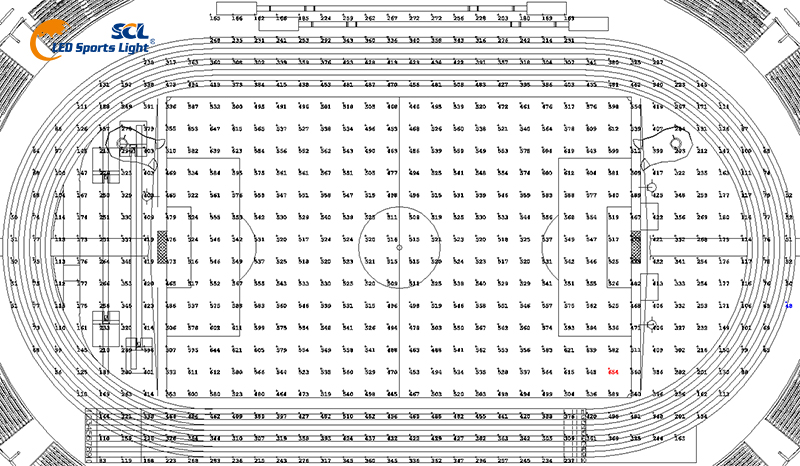
5. Design for Both Horizontal and Vertical Illuminance
A lighting layout that produces sufficient horizontal illuminance does not necessarily meet television broadcasting requirements.
Horizontal illuminance measures the light reaching the playing surface. It is important for ball visibility and overall playing conditions.
Vertical illuminance measures the light falling on vertical reference planes and is especially important for televised matches.
For broadcast venues, lighting needs to support cameras positioned at different locations around the stadium.
This means that luminaires should not all be aimed toward the ground from a single direction. Multiple overlapping lighting directions may be necessary to create balanced illumination on players and reduce excessive shadows.
The lighting layout should therefore be evaluated using:
· Average horizontal illuminance.
· Horizontal illuminance uniformity.
· Vertical illuminance from relevant reference directions.
· Vertical uniformity.
· Glare performance.
· Flicker and colour rendering requirements where applicable.
The exact criteria depend on the competition regulations and broadcaster requirements.
6. Consider Stadium Structures and Surrounding Conditions
A lighting layout may look effective in a computer simulation but perform differently if important physical constraints have not been considered.
Before finalizing the design, engineers should collect accurate information about:
Stadium architecture: Roof edges, spectator stands, advertising structures, and other obstacles can block light.
Pole foundations: Existing foundation positions may restrict where lighting towers can be installed.
Wind loading: Pole structures and mounting frames must be assessed for the weight and wind-loading characteristics of the proposed luminaires.
Maintenance access: Lighting equipment should be positioned so that inspection and maintenance can be performed safely.
Environmental impact: Light spill, glare, and unnecessary upward light should be controlled, especially near residential areas and transport infrastructure.
These factors are particularly important when designing lighting for existing stadiums, where the available installation positions may be limited.
7. Use Lighting Simulation Before Installation
Professional lighting simulation is an essential step in stadium lighting design.
Rather than selecting luminaires based on wattage or experience alone, engineers should evaluate the actual photometric performance of the proposed system.
A typical design process includes:
1. Collecting pitch dimensions and stadium structural drawings.
2. Confirming pole positions, mounting heights, and installation constraints.
3. Defining the competition and broadcasting requirements.
4. Selecting suitable LED luminaires and optical distributions.
5. Developing the lighting layout and aiming plan.
6. Simulating horizontal and vertical illuminance.
7. Evaluating uniformity and glare.
8. Adjusting luminaire positions, beam angles, and quantities.
9. Preparing installation drawings and technical documentation.
After installation, on-site measurements should be conducted to verify that the actual results correspond to the approved design.
This process helps reduce the risk of dark areas, excessive brightness, and unnecessary fixture replacement.
8. Real Football Stadium Projects: Why Layout Must Match Site Conditions
Different stadiums have different structural conditions, lighting requirements, and installation environments. A successful lighting solution must be adapted to the specific project.
SCL Sports Lighting has delivered football stadium lighting projects in multiple international markets.
Examples include:
The Mandela National Stadium, Uganda
The project uses SCL Sports Lighting QDZ-1500B LED sports lights, with a reported average illuminance level of 2,000 lux. The project demonstrates the importance of selecting suitable high-performance luminaires for major stadium lighting applications.
JKT Tanzania Football Club
The lighting installation uses QDZ-1500B luminaires mounted on 30-metre poles, with a reported illuminance level of 1,000 lux.
FC ILBIRS Arena
The main stadium lighting installation uses QDZ-1500B LED sports lights with a reported mounting height of 35 metres. The project also includes a separate training-ground lighting installation using QDZ-500B.
Cambodia Olympic Sports Center
The stadium lighting project uses QDZ-1500B luminaires installed at a reported height of 45 metres, achieving a reported illuminance level of 1,500 lux.
These projects illustrate how mounting conditions, installation height, and lighting equipment selection vary according to the specific requirements of each stadium.
SCL Sports Lighting focuses on professional sports venue lighting solutions, combining LED product development, photometric design, and project experience to support different types of football facilities worldwide.
Conclusion: A Good Stadium Lighting Layout Starts with Engineering
Designing a football stadium lighting layout requires more than deciding how many floodlights to install.
Pole positions, mounting height, beam angles, optical distribution, glare control, and broadcast requirements must all be considered as part of one integrated system.
For stadium owners and project developers, the most reliable approach is to begin with accurate site information, define the required lighting performance, and verify the proposed arrangement through professional photometric simulation.
A well-planned lighting layout helps create consistent playing conditions, improves visual comfort, and provides a stronger foundation for long-term stadium operation.
With professional design and suitable LED sports lighting equipment, stadiums can develop lighting systems that meet their current needs while remaining adaptable to future competition requirements.
https://www.stadiumlight.com/
GUANGDONG SEVEN CONTINENTS INDUSTRIAL CO., LTD
About Author