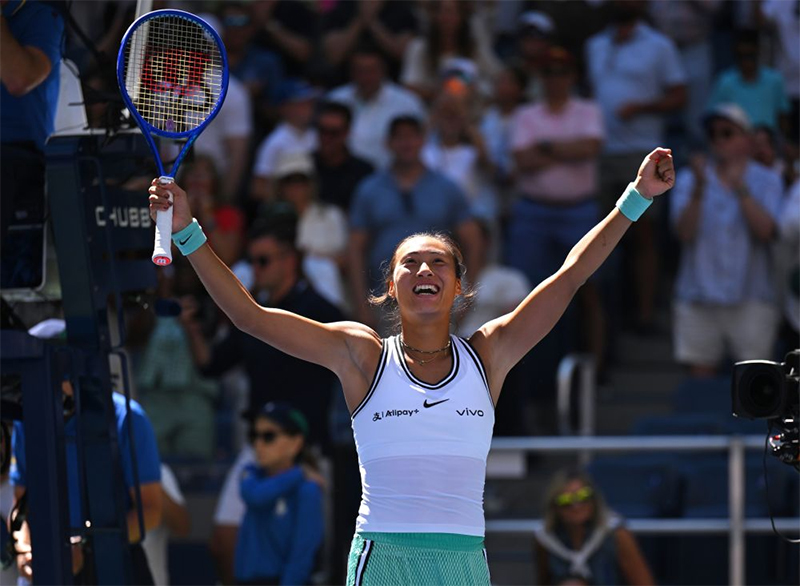
On the early morning of September 8, Beijing time, under the blazing lights of Arthur Ashe Stadium in Flushing Meadows, Zheng Qinwen staged another improbable comeback. After dropping the first five games of the opening set against world No. 8 Iga Świątek, she reeled off seven straight games to take it 75, then closed out the match 63. It was her second consecutive “05to7game” rally, following a similar escape against Madison Keys in the previous round. A journalist later tweeted: “Zheng down 05 is like Jordan in Game 6 or Tiger on Sunday – you just don’t count her out.”
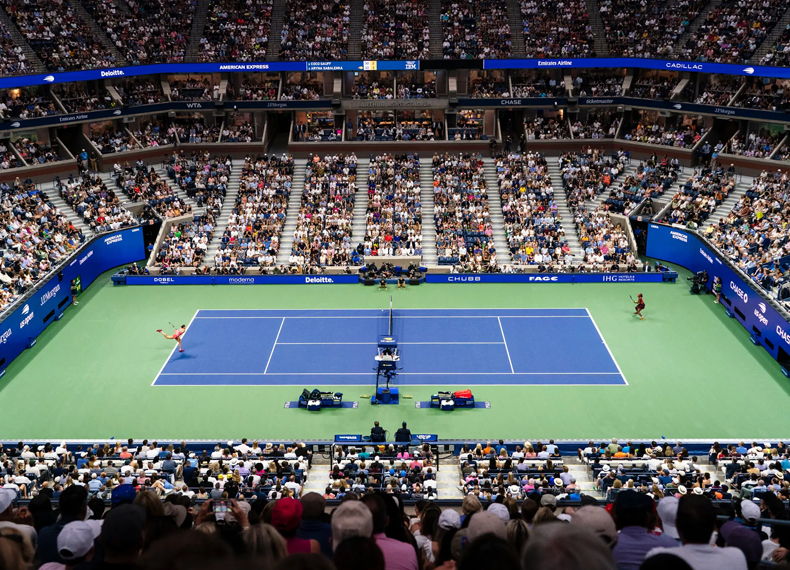
The comeback went viral on Chinese social media, with fans debating every point of her grit. But as I watched the live broadcast, something else caught my eye – the lighting of Arthur Ashe. As the US Open’s centre court, its system meets the world’s strictest standards for TV transmission and live spectator experience. Whether players sprint from baseline to baseline or the ball flies at high speed, the light remains stable, uniform, glarefree, and shadow-less.
That made me think: Zheng played during New York’s daytime, so the floodlights were mainly for broadcast clarity. But for most tennis courts, lighting is the sun – it determines whether players can track the ball, whether spectators enjoy the view, and whether cameras capture every splitsecond action.
Tennis lighting is far more complex than it seems
Tennis is a demanding sport. The ball is small and fast; players must judge its trajectory and landing in fractions of a second. That means court lighting must go beyond raw brightness – it requires high uniformity, excellent color rendering, and strict glare control – much stricter than many other ball games.
A Chinese sportslighting company, SCL Sports Lighting, has spent years specialising in this niche. They often point out that you cannot simply reuse a basketballhall design for tennis: basketballs are larger and follow more predictable arcs, while a tennis ball zips across the entire court, demanding even illumination and virtually no blind spots.
At the Guangdong Olympic Tennis Center – home of the WTA Guangzhou Open – SCL Sports Lighting took on a challenging retrofit. The old metalhalide lamps had degraded, creating uneven illuminance and severe glare, with light spill disturbing the surroundings. Instead of just swapping fixtures, they first ran optical simulations, then devised separate plans for the centre court and outer courts. The centre court got a smart control system that toggles between “HDTV broadcast,” “professional tournament,” and “training” modes; the outer courts received highefficacy LED sports with precision optics to eliminate glare. The upgrade restored this 2010 AsianGames venue to full international standard.
A similar story played out at the Shaanxi Tennis Center. For the 2023 Qinling Tennis Open – which drew nearly 400 players from over 30 Chinese cities plus Japan and South Korea – SCL Sports Lighting installed 300W LED sports professional court lights. The renovated claycourt facility not only met competition grade but also allowed flexible power reduction for public use, balancing elite play with daily operations.
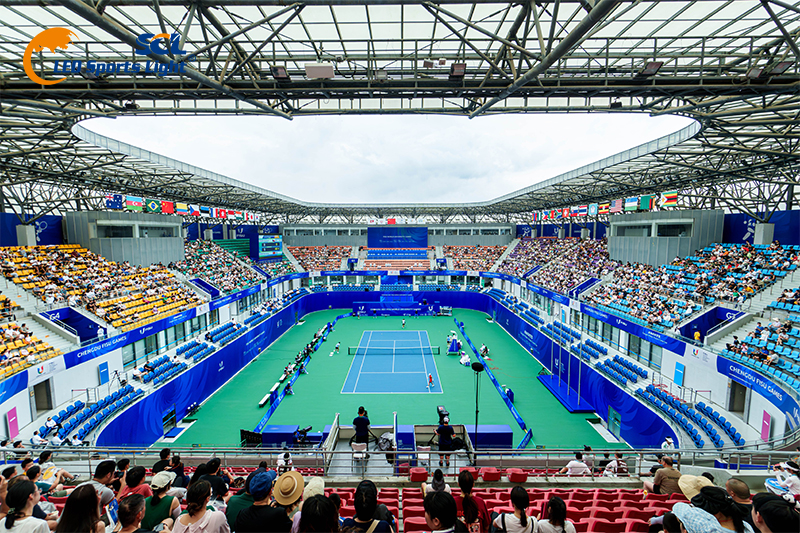
The largest overhaul came in 2020, when the Sichuan Chuantou International Tennis Center was upgraded to host the Chengdu FISU World University Games. Working with SCL Sports Lighting, the venue raised its lighting to Class VI HDTV broadcast standards – the highest for major international events. With the SCL Sports Lighting intelligent control system, the centre can seamlessly switch between grandtournament mode, professional match mode, amateur play, and training sessions. During the 2023 Chengdu Universiade, that very court witnessed China’s women’s singles player defeat her Czech opponent to advance.
Lighting is never merely about illumination
From the WTA stop in Guangzhou, to the red clay in Shaanxi, to the Universiade stage in Sichuan – all these upgrades share a common theme: sports lighting is not just about “being bright.” It directly affects players’ performance, the fans’ viewing experience, broadcast quality, and the venue’s longterm viability.
Zheng Qinwen’s two comebacks in New York relied on willpower, training, and that laserlike focus of “taking it one point at a time.” But without a uniformly lit court – without a system that eliminates glare and visual dead zones – even the strongest mindset can be eroded by poor visibility. As SCL Sports Lighting put it when illuminating the tennis courts at Jinshuiwan Sports Park: the core of tennis lighting, beyond meeting illuminance targets, is player comfort.
Of course, Arthur Ashe doesn’t use SCL Sports Lighting lights. But that doesn’t stop us from noticing that, back in China, more and more courts – from professional arenas to campus courts and community parks – are being lit with greater professionalism. Those lights may not be seen by millions, but they still create fair, comfortable, and focused playing environments for every player who steps onto the court.
From Flushing to Guangzhou, from Grand Slams to neighbourhood parks, good lighting is always more than just light. It is the prerequisite for a great match, the assurance for a precise return, and the reason every tennis lover can swing with full confidence.
https://www.stadiumlight.com/
GUANGDONG SEVEN CONTINENTS INDUSTRIAL CO., LTD
About Author